One of my favorite studies of Harry Potter is that of the ring composition found both in the individual novels and overall composition. To me, that very composition is what makes Harry Potter such a satisfying story. In my view, it’s a large part of the reason Harry Potter is destined to become a classic.
And it’s an integral part of the series many people are completely unaware of.
So what is ring composition?
It’s a well-worn, beautiful, and (frankly) very satisfying way of structuring a story. John Granger, known online as The Hogwarts Professor, has written extensively on it.
Ring Composition is also known as “chiastic structure.” Basically, it’s when writing is structured symmetrically, mirroring itself: ABBA or ABCBA.
Poems can be structured this way. Sentences can be structured this way. (Ask not what your country can do for you — ask what you can do for your country.) Stories of any length and of any form can be structured this way.
In a novel, the basic structure depends on three key scenes: the catalyst, the crux, and the closing.
The catalyst sets the story into the motion.
The crux is the moment when everything changes. (It is not the climax).
The closing, is both the result of the crux and a return to the catalyst.
In Harry Potter, you might recognise this structure:
Voldemort casts a killing curse on Harry and doesn’t die.
Voldemort attempts to come back to power
Voldemort comes back to power.
Harry learns what it will take to remove Voldemort from power.
Voldemort casts a killing curse on Harry and dies.
But all stories should have this structure. A book’s ending should always reference its beginning. It should always be the result of some major turning point along the way. Otherwise, it simply wouldn’t be a very good story.
What’s most satisfying about chiastic structure is not the basic ABA structure, but the mirroring that happens in between these three major story points.
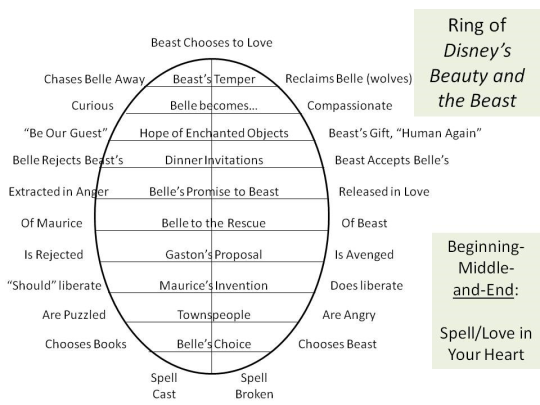
To illustrate what a more complicated ABCDEFGFEDCBA structure looks like, (but not as complicated as Harry Potter’s, which you can see here and here) Susan Raab has put together a fantastic visual of ring composition in Beauty and the Beast (1991), a movie which most agree is almost perfectly structured.
What’s so wonderful about ring composition in this story is that it so clearly illustrates how that one crucial decision of Beast changes everything in the world of the story. Everything from the first half of the story comes back in the second half, effected by Beast’s decision. This gives every plot point more weight because it ties them all to the larger story arc. What’s more, because it’s so self-referential, everything feels tidy and complete. Because everything has some level of importance, the world feels more fully realized and fleshed out. No small detail is left unexplored.
How great would Beauty and the Beast be if Gaston hadn’t proposed to Belle in the opening, but was introduced later on as a hunter who simply wanted to kill a big monster? Or if, after the magnificent opening song, the townspeople had nothing to do with the rest of the movie? Or if Maurice’s invention had never been mentioned again after he left the castle?
Humans are nostalgic beings. We love returning to old things. We don’t want the things we love to be forgotten.
This is true of readers, too.
We love seeing story elements return to us. We love to know that no matter how the story is progressing, those events that occurred as we were falling in love with it are still as important to the story itself as they are to us. There is something inside us all that delights in seeing Harry leave Privet Dr. the same way he got there–in the sidecar of Hagrid’s motorbike. There’s a power to it that would make any other exit from Privet Dr. lesser.
On a less poetic note, readers don’t like to feel as though they’ve wasted their time reading about something, investing in something, that doesn’t feel very important to the story. If Gaston proposed to Belle in Act 1 and did nothing in Act 3, readers might ask “Why was he even in the movie then? Why couldn’t we have spent more time talking about x instead?” Many people do ask similar questions of plot points and characters that are important in one half of a movie or book, but don’t feature in the rest of it.
Now, ring composition is odiously difficult to write, but even if you can’t make your story a perfect mirror of itself, don’t let story elements leave quietly. Let things echo where you can–small moments, big moments, decisions, characters, places, jokes.
It’s the simplest way of building a story structure that will satisfy its readers.
If there’s no place for something to echo, if an element drops out of the story half-way through, or appears in the last act, and you simply can’t see any other way around it, you may want to ask yourself if it’s truly important enough to earn its place in your story.
Further reading:
If you’d like to learn more about ring theory, I’d recommend listening to the Mugglenet Academia episode on it: x
You can also read more about symmetry in HP here: x
And more about ring structure in Lolita and Star Wars here: x and x
And about why story endings and beginnings should be linked here: x
“Some people say home is where you come from. But I think it’s a place you need to find, like it’s scattered and you pick pieces of it up along the way.”
From Washington, D.C., the rings would only fill a portion of the sky, but appear striking nonetheless. Here, we see them at sunrise.
From Guatemala, only 14 degrees above the equator, the rings would begin to stretch across the horizon. Their reflected light would make the moon much brighter.
From Earth’s equator, Saturn’s rings would be viewed edge-on, appearing as a thin, bright line bisecting the sky.
At the March and September equinoxes, the Sun would be positioned directly over the rings, casting a dramatic shadow at the equator.
At midnight at the Tropic of Capricorn, which sits at 23 degrees south latitude, the Earth casts a shadow over the middle of the rings, while the outer portions remain lit.
Fighter’s Blockis the best writing app I’ve come across in a long time.
You type in the amount of words you want to write and as you write, your mini lil avatar fights a monster. Each word you write acts a hit towards your monster, and once you’ve hit your word count the monster is defeated!!!
How cute!!!!
Work quick though as how long you spent not writing decreases your avatar’s health. It’s a productive fight to the death against the clock!
Best things about this app:
You can PAUSE it!!!! Need go get a cup of tea? Need to sneeze? You can!!!!!
Settings are adjustable! You can change the monster’s speed and the attacks!
You can change the theme and font!
You can level up!!!!! The number of words you write equals your EXP. You can unlock one avatar thus far, but I believe there may be more in the future!
You can minimise the fight above if it serves as a distraction, and only show the decreasing green bar.
Best of all: If you don’t hit the target word count in time, YOUR WORK DOES NOT DISAPPEAR. In the past I’ve lost so much work because I wasn’t typing fast enough, or sneezed.I cannot express enough how thankful I am that it presents a challenge where the consequence is a knock of pride and not a fit of rage.
Honestly, I urge all writers out there to give this app a go. It’s my new favourite thing.
Beyond this, consider how these professions might vary depending on who the customers are – nobles, or lower class. Are they good at their job or just scraping by? Do they work with lots of other people or on their own? City or village?
For younger characters:
Apprentice to any of the above
Messenger/runner
Page/squire
Pickpocket
Shop assistant
Student
Looks after younger siblings
(Images all from Wikimedia Commons)
Also consider:
Candlemaker Ferryman Factor (looks after business for an employer in another city) Tiler Cutler Beekeeper Apothecary Interpreter Furrier Moneylender/Banker Winemaker Tinker (small trader who repairs stuff) Nightsoil collector Customs officer
Also a bonus for animal related professions: Fowler (supplies game birds for eating) Warrener (catches rabbits on your land for you to eat) Ostler (looks after your horses) Falconer (looks after your falcons) Cocker (looks after your fighting cocks)
I need more fantasy rpg in my life that isn’t d&d-style. I think it’s time for some Sword & Backpack.
100 Jobs for Fantasy Characters (that aren’t knight or peasant)
Change the background colour of the pages to a mint green shade.
It is said that green is a calming colour, however, the main reason why I like this, is because I can write for a much longer period of time now, as a white background I used before made my eyes dry and exhausted after just a few hours of working.
It is basically much more soft and careful to the eyes. I can’t precisely explain why that is. I think it’s that by making a pinch softer contrast of the text and the background, your eyes does not get exposed to as much light.
Just make sure to not make the background too dark, or else your eyes will get exhausted do to over-fixating the lack of contrast between text and background.
And maybe you find a nice pastel/light background shade that fits you; give it a try.
Different things work out and fits for different people. And I just felt like sharing this.
Here’s the shade numbers I used to get my preferred colour:
Thanks for reading.
DUDE
You just solved a very real problem for me! Thanks!
For those who might not know where to find this: It’s in the Page Layout tab.
I had no idea this was possible before today!
Open Office Writer has a similar function under Format – Page – Background.
WHAT
Is this why I can write on yellow paper longer too?
I’m guessing it’s like using a coloured overlay?
You can also do this in Google Docs by going to File > Page Setup… > Page Color!
This also works for Scrivener, which is edited under Options -> Appearance (although you have to edit each area–General, Editor, Full Screen, etc–separately)
I’m really uncomfortable with stories where one person is like, really wary and Doesn’t Trust Anyone/Believe in Love because they’ve Been Hurt Before, and their love interest’s way of Teaching Them to Trust Again is to just utterly ignore their boundaries.
Especially if whenever our prickly protagonist calls them on it, the love interest shames them and insists it’s for the protagonists’ own good, because They Need to Learn to Trust Again.
That’s so fucked up.
After a bad situation, especially a bad relationship, it’s completely understandable and normal to be afraid of losing your autonomy again, of being railroaded and having your boundaries ignored like they were before. It’s completely understandable to be cynical about people’s intentions and to not want to fall in love when your love for someone has been weaponized against you before.
And the right way for someone to earn your trust should involve them taking the time to listen to and respect your boundaries and be there for you in a way that doesn’t threaten your autonomy. Someone who deserves your trust and love won’t try to bully or manipulate or coerce you, even “for your own good!”
Someone who wants to earn your trust and love should be willing to prove that they can be trustworthy. If it’s too much work for them – which is fine! – they shouldn’t be pursuing a relationship with someone who doesn’t feel safe without that work.
It’s not romantic for someone to decide that their interest in someone gives them the right to do absolutely anything, however inappropriate, that might result in a relationship. It’s really gross that we get sold this idea that it’s “romantic” to overrule people’s boundaries and autonomy, as long as your goal is to be in a relationship with them.
It’s not romantic. Stories where this happens are not good love stories. They’re stories of people afraid to trust, having their choices taken away from them yet again.


 Question of Smoke
