Can I give completely unsolicited advice to fantasy writers that I wish someone had given me when I was into fantasy writing? The cliche “write what you know” is bad advice if taken literally, it’s how we get books about depressed middle-aged creative writing professors who contemplate having an affair. But generally speaking it can be helpful. Tolkien wrote a medieval fantasy because he was the world’s foremost expert on medieval English literature. His book about Beowulf is still considered academically significant. He gave every race detailed languages because he was also a linguist. He wrote about giant battles because he was traumatized by his time in World War I and wrote during World War II. You don’t have to do any of this because that isn’t you. You are allowed to write a whole fantasy epic without a single battle (or you can make battle scenes modern urban melees because clashes of great armies aren’t a thing anymore.) If, say, you’re really into fashion, feel free to describe in painstaking detail every outfit that elves wear for all possible occasions. I promise you it’s no weirder than describing the dialects of tree people. What I’m saying is, you’re not Tolkien and that’s a very good thing because your voice is needed more. Let your freak flag fly and make the world that comes from you specifically.
When I send out my chapter to be read over by my beta readers, I always include a set of questions typed out at the bottom, grouped into different categories such as: plot, pacing, character, setting, etc.
You might want to tailor the questions depending on the genre or which chapter it is. For example, if it’s the first chapter you’ll want to ask them about how well your story managed to hook them, or if they managed to easily get an idea of the world you’ve introduced them to. If it’s the climax you might want to ask if the action scenes are fluid, and if the plot twist/s were predictable or surprising.
Here’s some example questions that you could use:
Opening Chapter:
What is your first impression of the main character? Do you find them likable? Annoying? Boring?
After reading it for the first time, what is your first impression? Was it cohesive and compelling? Boring and confusing?
Did the first sentence/paragraph/page efficiently grab your attention and hook you in?
If you were to read this chapter in a bookstore/library would you be convinced to buy it? Or would you need to read further before deciding? Why or why not?
Did you get oriented fairly quickly at the beginning as to whose story it is, what’s going on, and where and when it’s taking place? If not, what were you confused about at the beginning?
Does the first chapter establish the main character efficiently? Do they feel believable?
Characters:
Could you clearly imagine what the characters looked like? If not, who?
Who was your favourite character and why? Has your favourite character changed? (if this hasn’t changed feel free to skip this question)
Are there any characters that you do not like? Why do you not like them? (Boring, annoying, problematic, etc.)
Was there ever a moment when you found yourself annoyed or frustrated by a character?
Could you relate to the main character? Did you empathise with their motivation or find yourself indifferent?
Were the characters goals/motivations clear and understandable?
Did you get confused about who’s who? Are there too many characters to keep track of? Are any of the names or characters too similar?
Do the characters feel three-dimensional or like cardboard cutouts?
How familiar have you become with the main characters? Without cheating could you name the four main characters? Can you remember their appearance? Can you remember their goal or motivation?
Dialogue:
Did the dialogue seem natural to you?
Was there ever a moment where you didn’t know who was talking?
Setting/world-building:
Were you able to visualize where and when the story is taking place?
Is the setting realistic and believable?
How well do you remember the setting? Without cheating, can you name four important settings?
Genre:
Did anything about the story seem cliche or tired to you? How so?
Did anything you read (character, setting, etc.) remind you of any others works? (Books, movies, etc.)
Plot/pacing/scenes:
Do you feel there were any unnecessary scenes/moments that deserved to be deleted or cut back?
Do the scenes flow naturally and comprehensively at an appropriate pace? Did you ever feel like they were jumping around the place?
Was there ever a moment where you attention started to lag, or the chapter begun to drag? Particular paragraph numbers would be very helpful.
Did you ever come across a sentence that took you out of the moment, or you had to reread to understand fully?
Was the writing style fluid and easy to read? Stilted? Purple prose-y? Awkward?
Did you notice any discrepancies or inconsistencies in facts, places, character details, plot, etc.?
Additional questions:
What three things did you like? What three things did you not like?
Can you try predicting any upcoming plot twists or outcomes?
Was there ever a moment when your suspension of disbelief was tested?
Is there anything you’d personally change about the story?
Was the twist expected or surprising? Do you feel that the foreshadowing was almost nonexistent, or heavy handed?
Feel free to tailor these to your needs or ignore some of them if you don’t think they’re useful. Basically, your questions are about finding out the information about how others perceive your own writing and how you can improve your story.
In my first draft, I write terrible, on the nose dialog. Characters say exactly what they are thinking and the purpose of the conversation is incredibly clear. In real life, of course, it never happens that way, but if I don’t start out there, especially with high stakes conversations (i.e. fights over the tops of Volvos), I write myself around in circles trying to figure out what I actually need out of the conversation.
So instead I begin with what I need from the conversation, and when I circle back around on the next round of edits, I use observed speech patterns to fragment and color it. I often write down interesting or specific turns of the phrase when I hear them, and I always read my dialog out loud in the final rounds.
For me, writing a very atmospheric novel is a subtractive process.
What do I mean by that? You have the real world, with everything in it. Donegal, for instance, where I just was. You have every person who lives there doing every thing — the plumbers and the doctors, the cashiers and the bums. You have all sorts of buildings — cottages and clinics, grocery stores and knick knack shops. You have all sorts of days — misty one and sunny ones, hot ones and cool ones. All sorts of people — folks into the Kardashians and folks into knitting and folks into sheepdogs and folks into boats and folks into football.
Creating mood means taking away everything that doesn’t support your thesis — your desired atmosphere. So if you’re trying to lean on the ancient quality of Donegal, you pull out the pop culture references, you pull out the grocery stores with the florescent lights. You pull out the sunny, hot days. You narrow the lens until all the things you point at agree with your mood.
You can add things back in, of course, if you’re trying to balance a contemporary fantasy — you put things back in to ground you and remind the reader when it really takes place. But I add them in judiciously, and when I do, I try to lean on the same language I’d use to describe the ancient and evocative stuff. It makes it feel of a piece.
So the essence of grimdark is that everyone’s inherently sort of a bad person and does bad things, and that’s awful and disheartening and cynical. It’s looking at human nature and going, “The glass is half empty.”
Hopepunk says, “No, I don’t accept that. Go fuck yourself: The glass is half-full.” YEAH, we’re all a messy mix of good and bad, flaws and virtues. We’ve all been mean and petty and cruel, but (and here’s the important part) we’ve also been soft and forgiving and KIND. Hopepunk says that kindness and softness doesn’t equal weakness, and that in this world of brutal cynicism and nihilism, being kind is a political act. An act of rebellion.
Hopepunk says that genuinely and sincerely caring about something, anything, requires bravery and strength. Hopepunk isn’t ever about submission or acceptance: It’s about standing up and fighting for what you believe in. It’s about standing up for other people. It’s about DEMANDING a better, kinder world, and truly believing that we can get there if we care about each other as hard as we possibly can, with every drop of power in our little hearts.
Going to political protests is hopepunk. Calling your senators is hopepunk. But crying is also hopepunk, because crying means you still have feelings, and feelings are how you know you’re alive. The 1% doesn’t want you to have feelings, they just want you to feel resigned. Feeling resigned is not hopepunk.
Examples! THE HANDMAID’S TALE is arguably hopepunk. It’s scary and dark, and at first glance it looks like grimdark because it’s a dystopia… but goddammit she keeps fighting. That’s the key, right there. She fights every single day, because she won’t let them take away meaning from her life. She survives stubbornly in the hope that one day she can live again. “Don’t let the bastards grind you down,” is one of the core tenets of hopepunk, along with, “The arc of the moral universe is long, but it bends towards justice.”
Jesus and Gandhi and Martin Luther King and Robin Hood and John Lennon were hopepunk. (Remember: Hopepunk isn’t about moral perfection. It’s not about being as pure and innocent as the new-fallen snow. You get grubby when you fight. You make mistakes. You’re sometimes a little bit of an asshole. Maybe you’re as much as 50% an asshole. But the glass is half full, not half empty. You get up, and you keep fighting, and caring, and trying to make the world a little better for the people around you. You get to make mistakes. It’s a process. You get to ask for and earn forgiveness. And you love, and love, and love.)
Did you ever feel bored midway writing a scene? Or lukewarm? Do you feel like readers will jump full chunks of text?
Well, I used to feel that all the time.
I disliked outline with a passion. I thought it stole the magic away from creation. I thought it would trap my story in a box. Whenever I tried, I had no idea where to start, so I blamed outlining all over again. I would just write the first scene and allow my story to unfold itself. Although it is fun to let your story take the lead, it’s also chaotic.
I realized the importance of outlining on my third book. After months and months of hard work, my story turned out just… boring. Weak characters. A plot full of holes. No defined theme. Useless scenes. And a story that started with a goal, but changed so many times along the pages and accomplished almost nothing. Slow. Tedious. I was frustrated. I had to delete more than half to make it work. Even after rewriting, I wasn’t happy. That project was a major fail.
And failing was good, because, on my next project, I outlined.
I listed all arcs and, within the arcs, all scenes. I was mad. I wanted control. I wanted power. And I only sat down to write when I knew exactly what was going to happen from start to finish. I never wrote something that fast and effortlessly in my life. It didn’t take away the magic of writing, it simply gave me a sense of direction.
Outline is a map. And when you have a map, you have a journey to make.
If, like me, you are a bit lost, here’s how you can create the map for your next novel, or how to outline your book scene by scene. I’ll share with you three techniques, but will divide them into three posts. This is the part one. Or the Map Technique.
I advice you to grab pen and paper, and move away from the computer. Find a comfortable spot, maybe a coffee shop, or by your window. And let’s work!
Before outlining, write down your storyline in one phrase. I’ll be using an example to help you understand this technique. So, my storyline is:
Masked twins fight against a violent dictatorship.
Now, let’s start.
In every journey, we need a departure point and an arrival point. This is essential for a map. And, if it’s essential for a map, it’s essential for our outline. So, create the start (departure) and the end (arrival) of your story. With my example, it goes:
Twins have their lives destroyed by the government (departure)
They destroy the government (arrival)
Amazing!! Our map is taking form.
What else a journey must have? Milestones. Without milestones, we don’t know how far we are from the arrival. They are essential as well. But how can we put milestones in an outline? Easy. Between departure and arrival, you will list every important arc (or event, or key scene, or plot point) that must happen in order to take the plot from start to end. More or less like this:
Twins have their lives destroyed by the government (departure)
Their family is destroyed
They are taken in by their uncle
Uncle and twins plan their revenge
Twins find their mask
Twins perform small acts of justice
They gain the respect of the citizens
Government sees them as threat
Government tries to erase them
Twins perform huge acts of justice
They are almost killed
Uncle is killed
They perform one last act of justice by killing the dictator
Citizens claim for democracy
Democracy is installed
The twins destroy their masks
They destroy the government (arrival)
All milestones are placed, nothing too fancy, just a description of what we’ll be seeing along the journey. Good.
From milestone to milestone, we have roads, or sequences of roads. Between arcs, write down sequences of scenes that must happen to move the plot forward. For example:
Twins have their lives destroyed by the government (departure)
Their family is destroyed
Twins live with their father (who is an important journalist)
Father is abducted by the government
Social worker takes them to lonely uncle
They are taken in by their uncle
Twins and uncle can’t adjust to new life
They are all filled with grief
Uncle comes up with revenge plan
Uncle and twins plan their revenge
Twins trains while uncle perfects his plan
Twins and uncle adjust to new life
They become a family
Twins find their mask
Getting ready for their first step
Twins perform small acts of justice
They destroy factory that uses slave force
They kill politician who closed hospitals
They kill a famous torturer for the government party
They find their father’s file
Discover that father was tortured and killed
They gain the respect of the citizens
…
We are almost there…
Because, in every mile of the road, we have landscapes. Scenes are landscapes. And we need hundreds of different landscapes along the journey, beautiful ones, strange ones, unexpected ones… we need scenes. To every sequence, create as many scenes as you need:
Twins have their lives destroyed by the government (departure)
Their family is destroyed
Twins live with their father (who is an important journalist)
Father receives a journalism award
Twins enjoy the party
It’s time to go
Father drives them home
Father is abducted by the government
In isolated street, the car is stoped
Two man attacks them and abducts their father
One of the twins receive a scar on their face
Twins are left alone in deserted street
Social worker takes them to lonely uncle
Social worker takes them from the hospital
Drives them to poor area
Leaves them with unknown uncle
They are taken in by their uncle
Twins and uncle can’t adjust to new life
Twins can’t eat
Twins won’t leave the house
Uncle tries to get information on what happened to his brother, but fails
It’s believed that their father died
They are all filled with grief
Uncle and twins have a sincere talk about father, they tell past stories, they laugh, they cry
For the first time, they have dinner together
Uncle comes up with revenge plan
…
You can almost see the story playing inside your head like a movie. That’s the magic of a scene by scene outline. 😀
This last step is optional. But it’s a great exercise to trim the rough edges. Under each scene, catalog which character(s) you’ll need, what place(s) will be used, what does the scene accomplishes and ways it can unfold. Example:
so as some of you might know, i’m currently going to grad school for writing fiction and creative nonfiction. it’s a well-respected program, fully funded, with fantastic faculty and excellent classes. i’m learning a lot, so i thought even though i’m only just getting started (it’s a 2-year program), i’d share some stuff i’ve learned.
all writing is valid. scribbling a poem onto a cocktail napkin at an awkward family function is just as worthy of careful literary analysis as Faulkner. i’ve read stories and thought this is the worst thing i’ve ever read, i can’t take this seriously and then watched as established, widely published authors and academics provided a thoughtful and thorough criticism of it. treat all writing with respect, your own included.
all research is valid. i went on a rant about BDSM politics in queer culture, and this boy, who looked totally bewildered, asked me what BDSM was. after (hopefully) tactfully explaining it to him, he asked me, “so is that like…your research or something?” to which i replied, “…you could say that.” what i mean is, anything you are curious about is worthy of your attention and curiosity. anything you want to learn is worth learning. there is no such thing as a guilty pleasure when it comes to education.
good writing is a facet of place. the reason i think we believe our writing and research isn’t valid is because we are writing and researching in spaces that are not conducive to our interests. and when we see ourselves not yielding to those which we compare ourselves, it’s easy to think we’re “bad writers.” the key is to find places (publications, platforms, people, etc) that match your aesthetic, somewhere that your work might belong.
think of it this way: if you go to a function filled with foodies in formal wear talking about their yachts, you’re not going to bring celery sticks with peanut butter and raisins. that doesn’t mean ants on a log are a bad snack, but that this party is the wrong place for it. you bring that snack to a kid’s birthday party where you’ll probably have more fun anyway, and suddenly you’re a five-star chef.
don’t conform. take risks. this is something my workshop leader told me when i was concerned about workshopping my novella, and i told her i wanted to “tone it down.” i have gathered that the people who are considered experts in the field of writing are generally all looking for two things in any given work: creativity and whether or not the piece is doing something. (i’ll comment on the latter in the next point.) creativity is about being weird, about making things that don’t exist yet, using your knowledge of the world and filling in all the gaps with your own design. creativity is not about conforming to anyone else’s standards or expectations.
write to “do something” or create a conversation. admittedly i’m pretty accustomed to writing for the sake of self indulgence, which is great for inspiring first drafts but terrible for everything else. i’ve read works where the purpose of them was the complete romanticization or commentary of the self, and while that’s fine for people who already possess considerable ethos (re: celebrities), for people without it, these works aren’t adding to any conversation on any topic besides that writer’s introspection. (note, this is not “bad writing”; it just has a different place, generally a private journal.)
in the world of fanfic, we are all inherently adding to the conversation of a given canon. without that foundation, in the literary world your canon has to become something else: stories about big picture concepts like grief or oppression; stories subverting a popular generalization; stories that give new light to something. genre is thus not about conformity, but having a creative conversation with people who are interested in the same things you are. writing is about inserting yourself into the dialogue, adding to the lexicon of something greater than yourself.
where this breaks down, however, is the idea that some big picture topics are “overdone” such that they become tropes or cliches. tropes and cliches are indications of conformity. without a cohesive knowledge of your genre or interest to know which gaps need filled, it’s easy to fall into these traps of commonality.
positive and summative feedback is more helpful than negative feedback. a lot of people will disagree with me on this, but generally negative feedback is an indication that you didn’t understand the writers’ vision, and are superimposing your own vision over theirs. most people (in my community anyway) transform their negative criticism into questions for the writer to consider, or point out “what isn’t working.”
that said, the idea of summarizing what you just read is incredibly helpful, because it offers the writer insight into the things you picked up and stuck with you. it aligns the writers’ intentions with the reader’s perceptions to see if a story is working the way it should. this supposes, however, that you have an intention to your story, see: the “do something” point.
and mostly, positive criticism is the literal best. not only does it make writers happy, it encourages them to improve and points out the things they’re doing right so they can polish up what works and sweep away what doesn’t. never be afraid to offer compliments, and if something affected you personally or moved you, let the writer know. the best feedback i’ve given is when i point-blank told the writer, “this piece meant a lot to me, and here’s why.”
write about writing. this is a whole school of thought that i haven’t had time to delve into research-wise, but it’s something i make my students do, and it’s something i’m doing right now just by writing this. reflecting about writing solidifies concepts that you’ve learned so that they become easier to implement in future works. so when you’re done with a piece, write yourself a feedback letter about what you wrote, what you thought worked, and what you can improve for next time. if it’s a fic, maybe this could go in a blog post or an author’s note, or maybe you can just keep it for yourself in a journal. but thinking about writing and writing about writing is an enormously effective tool in development.
i hope this helps someone somewhere. even if it doesn’t, i think this is a good platform for reflection. you can read my other writing advice in my writing advice tag, or see a curation of my advice in my masterpost.
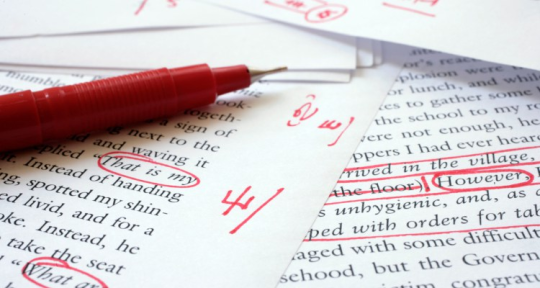
About twelve years ago I got advice about how to write and edit a story from the incomparable hollyblack, and I’ve finally, FINALLY managed to wrap my head around it and put it to use.
Well, that’s not completely fair. I have been using Holly’s advice for years in my fanfiction dalliances, but in my head that doesn’t entirely count, because fanfiction is a happy fantasyland for me, and I never edit fanfiction. So until now her advice and approach around editing has been sitting in reserve in my head, just waiting for its moment.
What Holly said to me about editing twelve years ago left me gobsmacked at the time. I couldn’t even begin to conceive of it. She said she actually likes editing.
She likes it. Like, she looks forward to it. Get that first draft finished so I can start the yay exciting editing! I couldn’t even fathom this at the time. She said, “When I’m editing, I know I can take something and make it so much better.”
I was stuck in an ugly place with this. Because while Holly was so optimistically seeing something less-than-great and turning it into something terrific, I was getting disheartened by the fact that this draft I wrote wasn’t so great in the first place. How could I have written something so awful? I couldn’t haul out the motivation to fix stuff when I was constantly being barraged with my own failures with each terrible, self-indulgent paragraph. It was like editing a tattoo with a kitchen knife.
The obvious answer seems to be: buck up, chum! This is what this writing business is about! Can’t hack it? Don’t bother, then. Out, out, out! No one said that to me. I said that to myself. And I took my own advice. Not because of anything Holly said. She was still happily talking about how great editing is, and telling me how to do it. It just seemed too hard to me. I didn’t think I could. I didn’t want to suffer like this. I couldn’t figure out how to treat stories the way Holly did.
Hence the twelve year gap.
But now I think I’ve figured it out, almost by accident. And I didn’t even have to grow a thicker skin!
It’s not that I had to get better at feeling crappy about what I’ve written, though I suppose that’s what some people do. Personally, I hate pain, so I had to find another way to do this if I was going to ever write anything again. I’ve learned that I can bypass the feeling horrible part by just taking the process seriously from the start and viewing it as the craft that it is.
My weapon against this terrible feeling is planning, outlining, fighting with an outline, planning some more, and then outlining again. I have tried to bring that story-critical eye in early and not letting it go until I have faith in the story structure and characters. Then, once I’m confident that the story itself is pretty sound, and I know it and the characters really well, I let myself go down happy-creation-floaty-time first draft writing. (I really like first draft writing.)
Having done that, it’s a lot easier to look my story and decide what I can do to make it better. I finally get it! I’m used to thinking about its structure and its flaws. I’m used to making decisions about it. I know what the parts are there to do, and I can begin to judge whether they do those things effectively or not. I’m more open to the conversation about fixing it, since I’ve been fixing it all along. I understand what it is.
People often tell me that they find the idea of planning before writing really boring. Where’s the joy of discovery? Where’s the creativity? Look: you don’t have to listen to me. Do what you like. But from my perspective, I think you’re blending elements together things that don’t fit together. Stories are not about words.
Stories are not about words! Stories are about characters and places, they are about themes and ideas, not words. If you think characters and places and themes and ideas come from the work of crafting beautiful sentences, I feel like you’re giving that other creative work seriously short shrift. Those are different activities. Both are important. But while we like to talk about thinking and writing fitting together, thinking and writing the draft of a story probably shouldn’t. Because I now do my planning and my draft writing separately, I’m able to see the story as the pieces that it is, and I can give each the attention it deserves.
This realization is what has allowed me to edit my first draft. And my second draft! Editing doesn’t hurt anymore! I am finally at the place Holly was telling me about twelve years ago! I’m not scared of my own draft anymore. If something’s not great, I will make it great now. It’s okay. I can do that!
I don’t even think the decisions or the work I need to do is all that different from what I was staring at twelve years ago and what I’m staring at now. The big different is my attitude, my understanding of my own story, and my approach.
This time, as I read through to edit, I found some parts where I got tired, I got lazy, I skimmed. I didn’t do the story justice. So I highlighted those bits and say, Oh, come on now, lazybum. Do this properly. Show don’t tell.
I can look at it and say, is that working? I can make big decisions. I can change the way things happen, or change the stakes. Because I understand the point and purpose of my story. I know my characters. I’m more confident about all of this, so I know how to fight for it.
I am taking out lines or paragraphs that I loved at the time, but are just too wheee look over here! in retrospect. And it doesn’t hurt to take them out this time. And it doesn’t even hurt to see where I was being lazy or making bad decisions. Because it’s only words; the decisions I’m correcting while I’m reading aren’t about whether this is a decent story or not, it’s not a judgement on me as a human being. It’s only about whether the story is coming through effectively using these paragraphs and these words and these scenarios. The story is still there. I didn’t build this thing out of eggshells. I worked hard on that story, I tested all the moving parts. The words need to bring that across, and if they aren’t doing the trick, out they go! If those particular words, if those particular scenes or decisions aren’t in service to that story, then I don’t want them there!
It doesn’t hurt anymore. Sometimes I just laugh at myself while I read something silly. Sometimes I wish I’d been a bit less lazy in parts, but that’s okay. As I’m editing, I’ve got a second wind. I can come in and lift up those parts that were flagging. I can make it better.
I get it, Holly. I finally get it. Thank you.
And I really hope you don’t mind me writing a whole post about it.
I don’t mind at all. I’m not sure I was helpful, but I am excited to see you figure out your process and how to make writing more enjoyable.
Now I need you to teach me how to love writing a first draft!
And I need to work on both writing first drafts in a dream-like stage and planning better so I can enjoy editing! WOO rewrites!


 Question of Smoke