Making your angst hurt: the power of lighthearted scenes.
I’m incredibly disappointed with the trend in stories (especially ‘edgy’ YA novels) to bombard the reader with traumatic situations, angry characters, and relationship drama without ever first giving them a reason to root for a better future. As a reader…
- I might care that the main siblings are fighting if they had first been shown to have at least one happy, healthy conversation.
- I might cry and rage with the protagonist if I knew they actually had the capacity to laugh and smile and be happy.
- I might be hit by heavy and dark situations if there was some notion that it was possible for this world to have light and hope and joy to begin with.
Writers seem to forget that their reader’s eyes adjust to the dark. If you want to give your reader a truly bleak situation in a continually dim setting, you have to put them in pitch blackness. But if you just shine a light first, the sudden change makes the contrast appear substantial.
Show your readers what light means to your character before taking it away. Let the reader bond with the characters in their happy moments before (and in between) tearing them apart. Give readers a future to root for by putting sparks of that future into the past and the present. Make your character’s tears and anger mean something.
Not only will this give your dark and emotional scenes more impact, but it says something that we as humans desperately, desperately need to hear.
Books with light amidst the darkness tell us that while things are hard and hurt, that we’re still allowed to breathe and hope and live and even laugh within the darkness.
We as humans need to hear this more often, because acting it out is the only way we stop from suffocating long enough to make a difference.
So write angst, and darkness, and gritty, painful stories, full of treacherous morally grey characters if you want to. But don’t forget to turn the light on occasionally.
Tag: writing advice
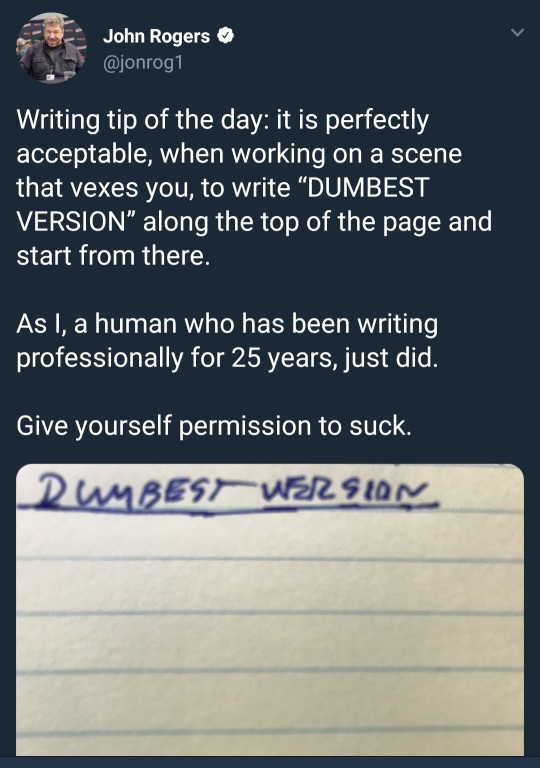
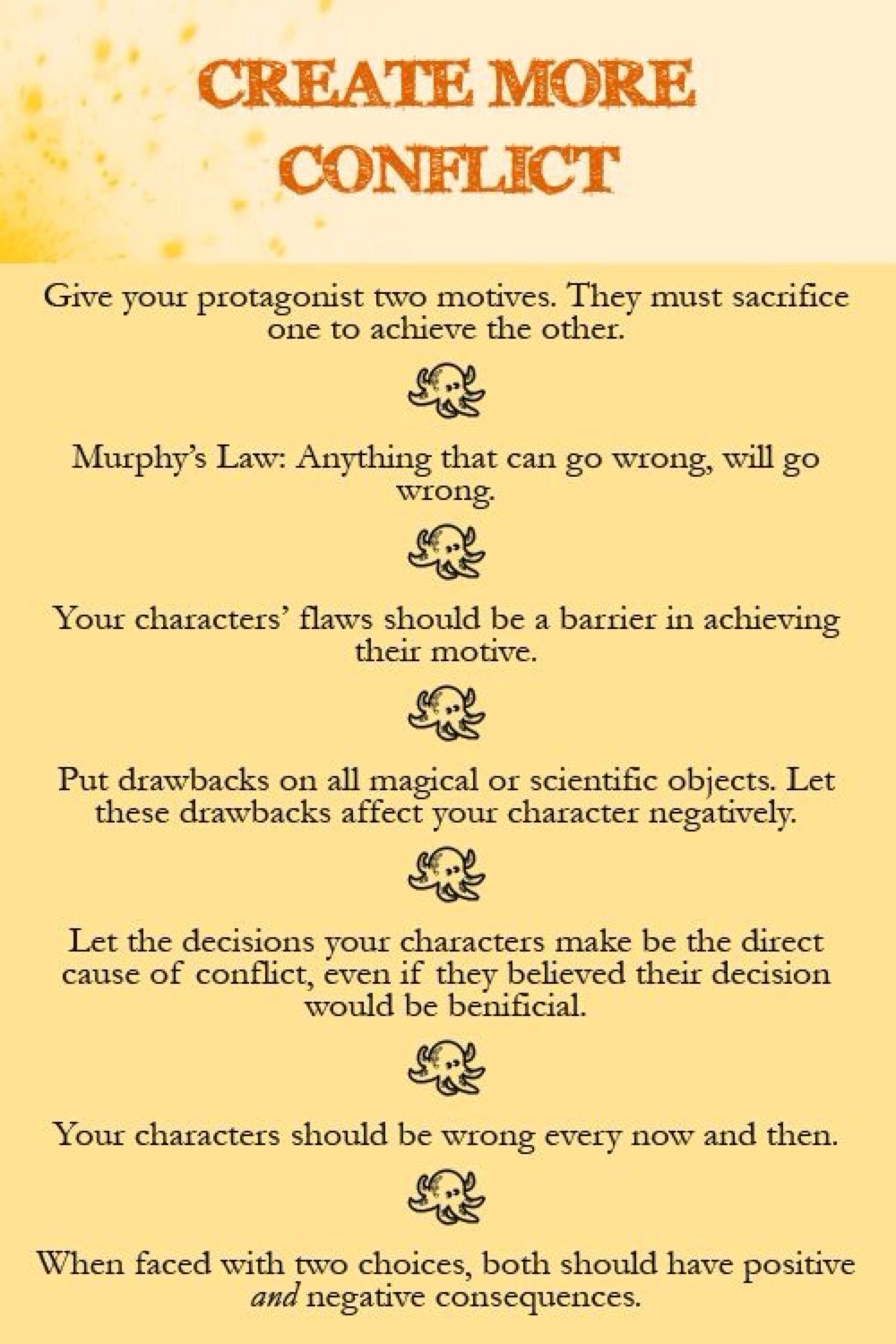
Thank you to whoever made this cute thing, very helpful. Here’s some advice to anyone who wants it!
Expository dialogue techniques that don’t rely on characters randomly explaining things to each other that they should already know, but do rely on your characters being obnoxious gits:
1. Character A fucks something up hilariously; character B upbraids them at great length about exactly what they did wrong.
2. Character A wildly misreads a situation; character B corrects their misconceptions.
3. Character A tells a complicated and implausible lie; character B points out the obvious holes in their story.
4. Character A can’t find their destination; character B provides rambling and discursive directions.
5. Character A has a straightforward question; character B requests a series of extremely pedantic clarifications.
The most important writing lesson I ever learned was not in a screenwriting class, but a fiction class.
This was senior year of college. Most of us had already been accepted into grad school of some sort. We felt powerful, we felt talented, and most of all, we felt artistic.
It was the advanced fiction workshop, and we did an entire round of workshops with everyone’s best stories, their most advanced work, their most polished pieces. It was very technical and, most of all, very artistic.
IE: They were boring pieces of pretentious crap.
Now the teacher was either a genius OR was tired of our shit, and decided to give us a challenge. Flash fiction, he said. Write something as quickly as possible. Make it stupid. Make it not mean a thing, just be a quick little blast of words.
And, of course, we all got stupid. Little one and two pages of prose without the barriers that it must be good. Little flashes of characters, little bits of scenarios.
And they were electric. All of them. So interesting, so vivid, not held back by the need to write important things or artistic things.
One sticks in my mind even today. The guys original piece was a thinky, thoughtful piece relating the breaking up of threesomes to volcanoes and uncontrolled eruptions that was just annoying to read. But his flash fiction was this three page bit about a homeless man who stole a truck full of coca cola and had to bribe people to drink the soda so he could return the cans to recycling so he could afford one night with the prostitute he loved.
It was funny, it was heartfelt, and it was so, so, so well written.
And just that one little bit of advice, the write something short and stupid, changed a ton of people’s writing styles for the better.
It was amazing. So go. Go write something small. Go write something that’s not artistic. Go write something stupid. Go have fun.
This needs to be framed on my wall!
Some real advice. Thanks for letting me know I’m on the right track, Neil!
“Your first draft won’t be perfect.”
We’ve all heard this a million times, but it’s a hard concept to actively apply to our writing.
Next time you feel like your writing (at any stage, not just first drafts) isn’t what you want it to be, try this out —
Go to someone you trust, and tell them:
“This scene turned out nothing like I wanted it to, but that’s okay. I’ve already done the hardest part by writing this terrible version, and even if I continue to make mistakes as I edit and rewrite, it will slowly get better from here. I’m learning something new through this and I’m growing as a writer.”
No more complaining to your author friends that your writing is awful and expecting them to pick your mood up. Go tell them your writing is awful and then tell them why that’s okay, and normal, and will work out in the end. I know you probably don’t believe it right now. But do it anyway.
It’ll get easier, slowly but surely.
Even if you don’t ever believe in yourself and your skill as a writer 24/7, developing a healthy way to cope with insecurity will always benefit you in the long run.
YES OMG
Absolutely.
@purrowler big mood
Things to Keep Out of Your Healthy Relationships!
(Alternately: how to identify problematic YA romances.)
Written by yours truly, contributions from @jltillary, @theinkrepository, @time-to-write-and-suffer, and @sakrebleu.
Non-consensual physical intimacy, especially in situations where it’s portrayed as being done for the benefit of the victim or situations where the victim forgives the forced intimacy because they decide they like it after it’s already been forced on them. Examples:
- Forcing a partner to accept physical comfort when they don’t want it.
- Kissing a partner in the middle of an argument.
- Framing consent as unnecessary simply because one person is attracted to the other.
- Stalking the other person, even for their own safety.
- Forcing the other person into some form of physical intimacy because they “liked it last time.”
- Implying that it’s normal for a certain physically intimate act to hurt and/or their partner should grin and bear it.
- Skipping over their partner’s preferred forms of intimacy in favor of what they want to do with/to their partner.
When in doubt: Consent should be explicitly given!!
Non-consensual communication. Examples:
- Physically stopping a partner from leaving in order to continue talking with them.
- Bringing up a topic the other person has made clear they don’t wish to discuss yet.
- Forcing the other person into conversations with people they previously showed they did not wish to talk with.
- Manipulating the conversation so that the other person shares a secret, especially one that doesn’t affect their partner.
Emotional manipulation. Examples:
- Telling the other person to do something (i.e. ‘go away’) as a test, where the person is at fault if they follow through and do as their partner asked.
- Blaming the other person for things beyond their control, especially “I wouldn’t be like this if not for you/your interests/your goals.”
- Claiming they’ll die (or kill themselves) if the other person leaves.
- Not wanting the other person to have friends of the same gender as their partner (i.e. a man not wanting his girlfriend to have any male friends).
- “If you really loved me you would do x, y, and z.”
- Demanding to be the most important part of their partner’s life, above and beyond their partner’s other responsibilities.
- Cheating on their partner as a form of punishment.
- Acting as though physical intimacy (or any other sort of intimacy) isn’t important, but then blaming the other person for not supplying it.
- Acting distant or cruel until the other person does what they want, or because the other person didn’t do what they wanted.
Demeaning actions and words, especially in instances where they blame the actions and words on internalized sexism, racism, etc as a shield, in instances outside of high-stress arguments, and whenever the character isn’t sincerely sorry for what they did or makes no point to change. Examples:
- Stating the other person’s interests or hobbies are inferior or a waste of time.
- Telling them they were look better if they did x, y and z.
- Demanding they stop doing something or start doing something else based on their gender, race, etc.
- Placing the other person in a subordinate role without their partner’s explicit consent.
- Not sharing certain pieces of information because they believe they know what’s best for their partner and don’t need the other person’s consent to act upon it.
- Bonus: Glorification of a partner simply for not demeaning the other person, (i.e. for acting like an average, decent human being,) especially when the partner in question boasts how amazing they are for loving their “curvy”/non-white/bisexual/not-like-other-girls/etc partner.
Please add more, if you feel so inclined!
Thank you!!! It makes me sick when a couple in a story act like this and it’s portrayed as “romantic”. Also I might add: Territorial behavior (such as overprotectiveness, taking care of the other when the other don’t want it, acting like they knows better what is good for their partner and doing something potentially illegal for “their safety” like locking them up) that is seen as romantic and sexy. And for some reason this is popular in YA??!
pick-me-ups for writers
for the self-conscious beginner: No one makes great things
until the world intimately knows their mediocrity. Don’t think of
your writing as terrible; think of it as preparing to
contribute something great.for the self-conscious late bloomer: Look at old writing as how far
you’ve come. You can’t get to where you are today without covering all
that past ground. For that, be proud.for the perfectionist: Think about how much you complain about things you love—the mistakes and retcons in all your favorite series—and how you still love them anyway. Give yourself that same space.
for the realist: There will be people who hate your story even if
it’s considered a classic. But there will be people who love your
story, even if it is strange and unpopular.for the fanfic writer: Your work isn’t lesser for not following canon. When you write, you’ve created a new work on its own. It can
be, but does not have to be, limited by the source material. Canon is not the
end-all, be-all.for the writer’s blocked: It doesn’t need to be perfect. Sometimes you have to move on and commit a few writing sins if it means you can create better things out of it.
for the lost: You started writing for a reason; remember that
reason. It’s ok to move on. You are more than your writing. It will be here if you want to come back.
 Question of Smoke