i still can’t believe that the incredibles is likely set in the 1960s
the entire film is designed with classic 50s-60s art styles, a lot of the interior design of the parr household is in 60s style, fashion is generally reminiscent of the 60s, in the beginning of the film all the photographs and video are grainy and shot in 60s style, the technology in bob’s office is very dated, when edna is going on her “no capes” rant she cites superheroes who died from cape designs and says their deaths were in the 50s, all the cars in the film have 60s models, any advanced tech we really see is seemingly kept secret from the general public, here’s a newspaper from the film:
may 16th, 1962
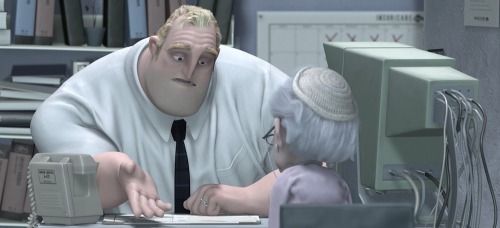
some people are saying that the technology on bob’s desk was too advanced for the 1960s but not really, in the 60s computers DID exist they were just big and bulky and small screened, which matches bob’s:
you could argue that some of the fashion isn’t very realistic to the 60s as some of the women wear pants, but women did wear pants in the 60s even if it wasn’t common. as for the mens fashion, it’s kinda spot on. the business suits with short sleeved button ups and skinny black ties, the turtlenecks, and for more dressed down looks wearing a t-shirt and jeans isn’t very unrealistic (and that little boy on the red tricycle, wearing a baseball cap, and chewing bubble gum is like classic 60s imagery)
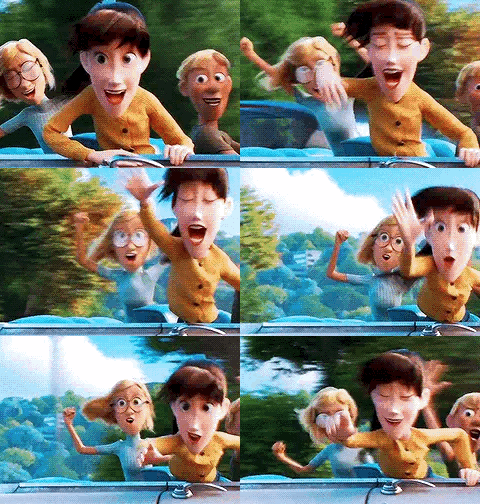
some outfits were likely oversights and/or them not wanting the time period to be too glaring. the sequel looks like they’re going to be making the womens wardrobe fit the stereotypical 60s timeframe better, as you can see in the trailer:
the writer and director of the incredibles has even said that he based the film on classic 60s superheroes and comics like god guys please use google search, why would i lie about this
I don’t understand how you can see Killmonger disrespect culture, attack women, basically was trained by military to tear down civilizations, his own father says he is disappointed in what he’s done, move to arm black people outside of Wakanda with high tech weapons (yes cuz giving Leroy and em cannon blasters is gonna help the cause) and y’all still fix ya lips to say he was right lol when Nakia exists. Wild.
I was waiting for someone to say this.
There’s a reason he was the villain. He killed his girlfriend in cold blood. His anger was understandable, true, but his methods abhorrent and destructive. The end result would have been huge amounts of death and chaos. No positive outcome.
[Killmonger was an amazingly written villain and a great, if not perfect, example of how to execute a “tragic backstory villain arc”. Due to his characters anger and Michael’s incredible acting it made Killmonger a character a large amount of people could empathize with. An amazing villain. Truly.]
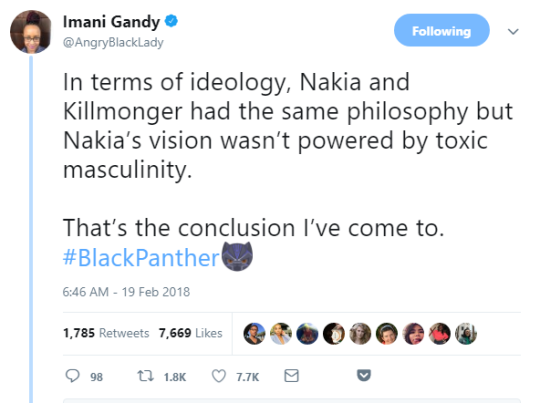
Nakia LITERALLY was team “let’s stop having Wakanda be an isolationist nation and help the worlds oppressed” from the jump and she doesn’t get enough credit.
I’m continuously terrified that people will think LGBT rights is a finished fight as soon as marriage equality passes nationally. There’s still so much extremely important stuff to get to. Marriage is not an end goal.
lesbophobia is so prevalent it’s a meme that we women don’t even know if we’re dating each other because we’re so afraid of being seen as predatory
I literally refuse to flirt with women because I never want to ever come onto someone unwanted. I never want to make a woman feel the way men make them feel
we’re so forced out of existence we don’t even allow ourselves to exist
after dying god informs you that hell is a myth, and “everyone sins, its ok”. instead the dead are sorted into six “houses of heaven” based on the sins they chose.
We arrived first at the House of Lust. “House” is a misleading term. It was more of a camp, spread over acres and acres of lush forest. There was a white sandy beach (nude, of course) full of copulating couples. There were little cabins sprinkled all along the path, from which orgasmic moans regularly came belting out. Men with six pack abs and women with perky breasts strolled by without even noticing me and God. They only had eyes for each other, tickling and pinching each other with flirtatious giggles.
“What do you think?” God asked as we passed a nineteen-way taking place in a pool of champagne. Little cherubs flitted overhead armed with mops and cleaning supplies, thankfully. “Lust is our most popular sin.” I eyed the supermodel-like figures of a couple passing nearby, and could easily see why. “You can look however you want. Hell, you can be whatever gender you want. No fetish is too taboo, and no desire can be denied here.”
It was quite tempting, but I wasn’t ready to make a permanent decision here. “Let’s see the others,” I told God.
We carried on to Greed. We passed rows and rows of mansions, each more opulent than the next. Some of them were so large that they would have had enough bed rooms to fit my entire hometown. And so many different styles: one second, we were in a beautiful French vineyard in front of a gorgeous chateau with the Alps in the background. The next second, a warm tropical beach with a modern mansion atop breathtaking cliffs. After that, a ski chalet in Colorado with a roaring fire in a hearth large enough to fit an ox. Each one had various Italian sports cars and Rolls Royces parked in front, with the occasional smattering of boats, helicopters, etc.
“Any material desire you ever wanted,” God explained. “Your own world, where you can have everything. You want the Hope Diamond? You can fly to Washington DC in your own solid gold helicopter and buy it from the Smithsonian. Hell, you can just buy the Smithsonian.”
Also tempting, but I decided to keep looking.
Gluttony was next up. Tables and tables of the very finest foods: beautiful steaks cooked medium rare; butter-poached lobster tail; fresh oysters on a half shell; exotic wines in dusty bottles that had been hiding in the cellars of the world’s finest restaurants. Everyone had a glass of champagne in hand and simply lounged on couches and chairs near the tables, eating endlessly. As soon as the inhabitants took a bite, the food just instantly came back. My mouth watered even watching them.
“In every other House, the food is practically sawdust compared to Gluttony,” God explained. “You haven’t truly experienced heaven until you’ve been to Gluttony.”
I shook my head, and we kept moving.
Sloth was as you’d expect. An endless sea of the softest mattresses, stacked with cushions and pillows that made the story of the princess and the pea seem minimalist. Little angels visited each resident, giving them massages that made them all melt into their blankets.
Wrath was… well, a lot like what I’d expect Hell to be like. Fire, brimstone, whips, torture.. you know, the works. Except here, you weren’t the one being tortured. Every enemy you’d ever made in your real life was now under your thumb. “Lots of people choose their fathers,” God explained. “Lots of grudges against parents in general, you know. But you’re not limited to that. Someone beat you out for a big promotion back on Earth? Take your pound of flesh here.”
Then we arrived at Envy. It looked… well, a lot like home.
“Go on in,” God said, gesturing toward the door. I turned the knob and walked in… and found Emily waiting inside. She ran forward, wrapped her arms around my neck, and planted a kiss right on my lips. “Welcome home, honey.”
I looked back toward God. “Oh, don’t be coy,” he said. “You have no secrets from me. We all know that you were in love with your best friend’s wife.” She didn’t seem to hear him at all; she went back into the hall. “We all know that you just settled for your own wife while secretly pining after her. Well, this is your chance to live happily ever after.”
I peered into the kitchen. Emily was baking something, wearing nothing but an apron. Her curly black hair fell softly over her shoulder as she whisked ingredients. She turned back, noticed I was observing her, and an enthusiastic smile spread across her face.
“It’s what you’ve always wanted, isn’t it?” God whispered in my ear.
I wanted to take it. God damn did I want to take it. But I shook my head.
God seemed puzzled. “You need to make a decision,” he told me.
“I haven’t seen Pride yet.”
He scoffed. “No one ever wants Pride, trust me.”
“Well, I want to see it.”
_________________________
Pride was boring. Just a row of workbenches in a bare white room.
“I don’t get it,” I told God.
“Yeah, no one does,” he answered. “That’s why no one ever chooses it. Doesn’t cavorting in Lust sound better than sitting here building little trinkets for the rest of eternity? Wouldn’t you rather gorge yourself in Gluttony? Or spend time with Emily in Envy?”
I considered the options again. “I pick Pride,” I finally told him.
He narrowed his eyes. “What? Look at it!” He gestured around the room again. There wasn’t much to look at. “Why would you choose this for the rest of time?”
“Because you don’t want me to pick it,” I told him. If he was really God, he’d know what a contrarian I can be. And I knew he was hiding something, trying to pretend like Pride didn’t exist. There was something special about it.
God scowled back. “Fine.” He led me over to one of the workbenches. In the center, there was a black space. A blank, empty void that went on forever. “Here’s your universe,” he said. “You’ve got seven days to get started.” He took his seat at the bench next to me and went back to tinkering in his own world. After a long pause, he finally spoke again: “You know, it might be nice for me to actually have some company for once.”
FUCKING I MEAN.
IT’S LIKE 7AM AND I LOVE GONNA REBLOG SO I CAN READ THIS SHIT AGAIN
oxford was built and operational as a college before the rise of the mayans and cleopatra lived in a time nearer to pizza hut’s invention than to the pyramids being built
I need a noncomprehensive history book that covers Known World History in time periods, like “in this century, all this shit was happening concurrently” and not just all spread out so I have to piece it together like some unpaid uneducated scholar
natalie portman radiates such a terrifying energy i can’t describe it….. it’s not exactly evil but it’s not warm either…. i feel like she could unhinge her jaw and drag me into the ocean like a kraken but she wouldn’t bc it’s undignified
Wanna know why?
“Oscar-winning actress Natalie Portman told the crowd at Saturday’s Women’s March in downtown Los Angeles that she experienced what she calls “sexual terrorism” as a 13-year-old after the release of the film The Professional.
Portman described her pride and excitement in releasing the film, only to encounter sexually explicit messages both directed toward her and made about her.
”I excitedly opened my first fan mail to read a rape fantasy that a man had written me,” she recalled. “A countdown was started on my local radio show to my 18th birthday, euphemistically the date that I would be legal to sleep with. Movie reviewers talked about my budding breasts in reviews.”
The experience, she said, changed the way she expressed herself publicly, in order to limit the ways she could be objectified by others.
”I understood very quickly, even as a 13-year-old, that if I were to express myself sexually, I would feel unsafe,” she said. “And that men would feel entitled to discuss and objectify my body to my great discomfort. So I quickly adjusted my behavior. I rejected any role that even had a kissing scene and talked about that choice deliberately in interviews. I emphasized how bookish I was and how serious I was. And I cultivated an elegant way of dressing. I built a reputation for basically being prudish, conservative, nerdy, serious, in an attempt to feel that my body was safe and that my voice would be listened to.”
I was introduced to the concept of hermeneutical injustice a couple days ago and it’s been blowing my mind. I’ve been struggling for a while to reconcile consent and asexuality, specifically in the context where asexuality isn’t known. If asexuality isn’t an option, how can someone’s consent be truly free? Anagnori’s post on Asexuality and Consent Issues sums it up well:
Consent can only be freely given when all people involved are mentally, physically, socially and financially able to say “No.” An imbalance of power or of information limits the options that one of the partners can take, and it casts doubt on the voluntariness of the relationship. […] How many asexual people consent to sex that they would not have consented to if they grew up knowing that asexuality was a good, normal, and healthy way to be? How many people are pressured or manipulated into sex because they believe that they need to be fixed?
I’ve had countless conversations with other aces who feltpressured into sex before they discovered asexuality, not necessarily because their partner was standing over them saying, “You must have sex with me or the heavens will smite you with thunderbolts” (although that has happened to some people), but because they couldn’t think of a “good” reason why they shouldn’t want to have sex. They loved their partner. They had birth control. They hadn’t experienced trauma. What was stopping them? Why didn’t they want it?
This is a personal topic for me. I wouldn’t have consented to a lot of things in a previous relationship had I known that asexuality existed – had I known that asexuality is “a good, normal, and healthy way to be” – and there’s a lot of hurt in that for me. I was blamed and blamed myself for not being sexually attracted to my partner; after realizing that I’m asexual, I was able to stop blaming myself for not feeling sexual attraction. But then I became angry. I was angry at my ex for pushing sex. I was angry at the abysmal state of sex ed. I was angry at compulsory sexuality. And I was angry at myself. Why hadn’t I had the courage and confidence to say no?
I blamed my ex for a while – why did he push it when I said no so many times before? why did he enjoy it when I was clearly disinterested? – but that didn’t feel quite right. I said yes multiple times, and people can’t read minds. So then I was back to blaming myself. Perhaps if I truly felt so strongly that I didn’t want to have sex, I would have said no every time. But that doesn’t encapsulate the pressure and feeling of brokenness that I felt – the unspoken social norm that because I didn’t have a “good” reason to “deny” him, saying yes was a given. The problem is that I was left with no way to explain my hurt. On the surface, it shouldn’t have been a big deal: he said yes, I said yes, therefore everything was consensual. The problem is, had I known about asexuality, I would have said no. It felt like a wrong had occurred, even though there was no one to blame. And that is hermeneutical injustice.
Coined by Miranda Fricker in her book, Epistemic Injustice: Power and the Ethics of Knowing, hermeneutical injustice is “the injustice of having some significant area of one’s social experience obscured from collective understanding owing to a structural identity prejudice in the collective hermeneutical resource.” twin_me’s introduction to epistemic justice explains it well:
Hermeneutical injustice is scary because of the word “hermeneutical.” What we need to know is that “hermeneutical” just means “having to do with interpreting things” – and in our case, “having to do with interpreting our experiences.” The foundational idea is fairly straightforward: having certain concepts helps us interpret our experiences. (Imagine trying to interpret the experience of anger or jealously or being “in the zone” without having a name or concept for it). But, how is this injustice? The answer to this question lies in the fact that a lot of experiences never become concepts that everyone learns. In fact, the concepts that everyone learns are often the concepts of people who are doing pretty well in society – not marginalized people. So, roughly, hermeneutical injustice happens when the reason that a relevant concept doesn’t become part of the collective consciousness is because the concept interprets an experience that is felt primarily by a marginalized group. Because [there] is no concept for the injustice the person is feeling, the person can’t express, understand, or know it.
Fricker discusses a few case studies, the central case being the story of a woman, Wendy Sanford, who had severe depression after the birth of her first child. She blamed herself for her depression, and her husband blamed her as well. A friend convinced her to go to a workshop on women’s medical and sexual health, where one of the small groups she was in started talking about postpartum depression. Suddenly, she was able to make sense of her experience. Just knowing that she was experiencing a real phenomenon that other people experience changed her life. Even though many people experienced postpartum depression, it wasn’t talked about, and it wasn’t in the collective consciousness.
The parallel between Wendy’s revelation about postpartum depression and an asexual person’s revelation about asexuality is clear, particularly when the asexual person is in a relationship with a non-ace person. Fricker writes, “the primary harm of hermeneutical injustice consists in a situated hermeneutical inequality: the concrete situation is such that the subject is rendered unable to make communicatively intelligible something which it is particularly in his or her interests to be able to render intelligible.” In sexual situations, an asexual is left without hermeneutical resources to interpret their feelings. The collective hermeneutical lacuna around asexuality – or to go one step further, the lacuna around asexual feelings in general, i.e. lack of sexual attraction without a socially prescribed reason – harms the asexual person’s ability to consent. Learning about asexuality is therefore not only a hermeneutical breakthrough, but an overcoming of epistemic injustice.
Asexual invisibility is harmful in more ways than specific situations of sexual consent, too. Fricker asks, “Is hermeneutical injustice sometimes so damaging that it cramps the very development of self?” She gives an example using Edmund White’s autobiographical novel, A Boy’s Own Story. As he describes his love for a friend, the collective hermeneutical resources classifying homosexuality as a “sickness” or an “adolescent stage to pass through” conflicts with his own feelings. His sense of self is being formed by collective understandings of homosexuality, which are more powerful than his singular personal experiences. “The primary harm of hermeneutical injustice, then, is to be understood not only in terms of the subject’s being unfairly disadvantaged by some collective hermeneutical lacuna, but also in terms of the very construction (constitutive and/or causal) of selfhood. In certain social contexts, hermeneutical injustice can mean that someone is socially constituted as, and perhaps even caused to be, something they are not, and which it is against their interests to be seen to be.”
Similarly, an asexual’s sense of self is formed by collective understandings of sexuality, leading to feelings of brokenness, abnormality, and isolation. When the collective hermeneutical resources construct sexuality as default, there is no way develop a healthy asexual selfhood. Moreover, asexuals are socially constituted as sexual where, particularly in intimate and physical relationships, it is against their interests to be seen as such. We see the harm in this played out again in issues of consent. The collective understandings of sexuality are more powerful than the singular personal experiences of asexuals, and an asexual person doesn’t have the courage and confidence backed by hermeneutical resources to say that their feelings and experiences are valid and must be respected by their partner.
When you find yourself in a situation in which you seem to be the only one to feel the dissonance between received understanding and your own intimated sense of a given experience, it tends to knock your faith in your own ability to make sense of the world, or at least the relevant region of the world. […] hermeneutical injustice not only brings secondary practical disadvantages, it also brings secondary epistemic disadvantages [… that] stem most basically from the subject’s loss of epistemic confidence. The various ways in which loss of epistemic confidence might hinder one’s epistemic career are, to reiterate, that it can cause literal loss of knowledge, that it may prevent one from gaining new knowledge, and more generally, that it is likely to stop one gaining certain important epistemic virtues, such as intellectual courage.
When I learned about asexuality, it was like the floodgates opened. Suddenly there was a term for my experiences and an entire community built around discussing them. Backed by this collective knowledge, I’m much more confident in my self, my boundaries, and my relationships. However, I was still left with pain and bitterness about my previous relationship; I didn’t have a model or framework in which to analyze a situation where lack of knowledge – for which no one was accountable – would’ve affected consent.
Now, we can talk about these consent situations as hermeneutical injustice. It encapsulates the visceral feeling that something wrong has occurred, yet no one involved in the situation is directly responsible. Fricker concludes, “hermeneutical injustice is not inflicted by any agent, but rather is caused by a feature of the collective hermeneutical resource – a one-off blind spot (in incidental cases), or (in systematic cases) a lacuna generated by a structural identity prejudice in the hermeneutical repertoire. Consequently, questions of culpability do not arise in the same way. None the less, they do arise, for the phenomenon should inspire us to ask what sorts of hearers we should try to be in a society in which there are likely to be speakers whose attempts to make communicative sense of their experiences are unjustly hindered.”
When people say that sexuality is a personal matter and no one should care what people do (or don’t do) in bed, it means that the collective hermeneutical lacuna around non-heterosexualities will never be filled. When people are confused on why some asexuals feel the need to “come out”, I can now explain hermeneutical injustice. As Anagnori concludes:
This is why asexual awareness is so important. We need everyone in the world to know that we exist, not only so that we can be respected, but so that millions of other asexual people can have the power to make informed, confident choices about their own sexuality. We need asexual people everywhere to know that they are not broken, abnormal or wrong for what they are feeling, and that they have the right to reject sex at any time, for any reason. When asexual people can confidently say “No,” then they will also be able to say “Yes” with more certainty and weight, and they will have the option of forming sexual relationships that respect their asexuality and bring them happiness.
In her article, Queenie goes on to state that the simple knowledge of the existence of asexuality might not be enough to counter compulsory sexuality, i.e. aces aren’t “suddenly free from pressure and expectations” after realizing they’re asexual. I completely agree. To analyze other consent situations, there’s Emily Nagoski’s model of consent (with addendums made by other people, as mentioned in the first paragraph of Queenie’s post). I’m also particularly fond of Lisa’s non-binary power model of consent. However, for the very specific case of an asexual person consenting to sex when either partner had no knowledge or understanding of asexuality, I believe that hermeneutical injustice is the best interpretation of the situation.



 Question of Smoke