labeling fictional characters as strictly good or bad people and demanding that the narratives you consume adhere to strict binaries of good and evil at the cost of ignoring any sort of emotional or moral complexity present in said narrative (or worse, labeling it “problematic”) is uhhhhhh……..boring
Tag: purity discourse
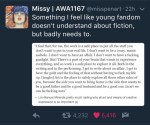
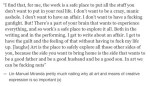
THIS. I saw a post the other day that literally said if you do it to a fictional character, you’ll do it in real life.
No. Just NO.
I’m so glad someone put it into words.
Lin-Manuel Miranda is a legend, and he’s absolutely right.
And I really feel like there are parts of fandom that don’t get or don’t believe this, and I think that’s troubling. I’ve seen arguments that people shouldn’t have dark fantasies, or that bad impulses in themselves make a bad person. I’ve seen so much shaming over thoughts.
And if you get to a point where it’s bad to have dark thoughts and it’s bad to wonder what something would be like and it’s bad to put yourself in the shoes of anyone who isn’t “pure”, if fiction is no longer a realm where you can confront and explore, but an ongoing test of moral purity… well, maybe not everyone’s brain works like mine, but I feel like that takes away something incredibly important to being human.
IMO the boundary between critique, purity culture, and censorship is this:
it is responsible, and the mark of a good audience, to critique problematic elements in the media we consume. For example, I love gothic lit – but a lot of it is incredibly sexist and racist. I can acknowledge that these elements are a problem and objectionable while still enjoying the piece for a multitude of other reasons. I can also say to myself “if I ever want to write my own gothic lit, here are some elements I should avoid.” Or, if I do want to tackle the issues of racism and sexism in my future gothic lit, then I can say “I will avoid writing in a way which implicitly or explicitly condones racism or sexism, while still emulating the praiseworthy elements of gothic lit.”
In essence, the fundamentals of intersectional media critique is this: “these elements of [x media] are problematic and we should rethink them in future media, both as audiences and as creators.” By rethinking these elements, I don’t mean utterly doing away with them, but rethinking how we approach them and how we read them.
We enter purity culture when our statement moves from “these elements of [x media] are problematic and we should rethink them in future media, both as audiences and as creators,” and becomes “these elements of [x media] are problematic and therefore anyone who consumes or creates [x media] is condoning everything about [x media].” The implication here is that, if one wants to be a good person, one should avoid [x media], because to do otherwise is to either implicitly or explicitly condone everything in [x media]. This type of attitude towards media is very common in conservative religious circles.
It moves fully into censorship when the statement moves from “these elements of [x media] are problematic and therefore anyone who consumes or creates [x media] is condoning everything about [x media]” and becomes “these elements of [x media] are problematic and therefore nobody can consume or create [x media] for any reason.” Those who break this rule are seen as evil and shunned. This type of attitude toward media is very common in fundamentalist circles.
A culture of censorship is the natural outcome of purity culture, because purity culture by its very nature seeks purity until even the whisper of objectionable content, in any context, is suppressed.
I would wager a guess that many people who are against anti culture are familiar with either these toxic conservative or fundamentalist attitudes towards media, and we are alarmed by their striking similarity with antis’ attitudes towards media. It is most certainly why I am against anti culture.
Let people grow.
When I was younger I was very right-wing. I mean…very right-wing. I won’t go into detail, because I’m very deeply ashamed of it, but whatever you’re imagining, it’s probably at least that bad. I’ve taken out a lot of pain on others; I’ve acted in ignorance and waved hate like a flag; I’ve said and did things that hurt a lot of people.
There are artefacts of my past selves online – some of which I’ve locked down and keep around to remind me of my past sins, some of which I’ve scrubbed out, some of which are out of my grasp. If I were ever to become famous, people could find shit on me that would turn your stomach.
But that’s not me anymore. I’ve learned so much in the last ten years. I’ve become more open to seeing things through others’ eyes, and reforged my anger to turn on those who harm others rather than on those who simply want to exist. I’ve learned patience and compassion. I’ve learned how to recognise my privileges and listen to others’ perspectives. I’ve learned to stand up for others, how to hear, how to help, how to correct myself. And I learned some startling shit about myself along the way – with all due irony, some of the things I used to lash out at others for are intrinsic parts of myself.
You wouldn’t know what I am now from what I was then. You wouldn’t know what I was then from what I am now.
It distresses me deeply to think of someone dredging up my dark, awful past and treating me as though that furiously hateful person is still me. It distresses me to see others dredging up the past for anyone who has made efforts to become a better person, out of some sick obsession with proving they’re “problematic.”
Purity culture tells you that once someone says or does something, they can never go back on it. That’s a goddamn lie. While it’s true that some remain unrepentant and never change their ways and continue to harm others, it’s important to allow everyone the chance to learn from their mistakes. Saying something ignorant isn’t murder. Please stop treating it that way. Let people grow.
Still call it out and question it ….
Bruh. No. Listen. Call out what people do now, absolutely. If they haven’t changed, call them out on their record. This post is explicitly not about people who HAVEN’T changed. What this post IS saying is, if someone is making an effort to be a good person, don’t go digging around in their past for evidence that they were once for what they’re now against, or once against what they’re now for, as “proof” of what they “really think,” because people’s opinions and beliefs can change.
The obsession with finding shit in someone’s past and then claiming that a questionable or even sordid past negates all possibility of a good present needs to become extinct. Gold-star activism and purity culture are bullshit and we need to collectively reject the fuck out of them.
If someone has changed for the better, don’t harass them about what they were like before they fuckin’ changed. That’s shitty and it needs to stop.
Gold-star activism and purity culture are bullshit and we need to collectively reject the fuck out of them.
THIS
you don’t need purity in the material you consume
you have a brain, you are capable of critical thinking, you can sift through the material and keep what is edifying for you and discard what isn’t
flaws don’t necessarily make material worthless
all right i queued this last night because i was already posting a lot and didn’t want to flood anyone’s dash but you guys i need to talk about this more.
like, okay. i grew up REALLY STRICT christian. like. every piece of media i consumed underwent a fine-toothed comb by my parents to be sure there wasn’t anything “sinful” in it. I got into a tearful, screaming fight with my mother over whether I was allowed to watch a piece of educational children’s material on PBS because one of the characters said “damn” once.
(I’m still not sure they did. In retrospect, I think my purity-focused mother misheard something and, having her suspicions confirmed that you couldn’t trust any “secular” source not to be sinful, reacted accordingly.)
(Pay attention, that parenthetical was also relevant.)
Do you know what my teenage rebellion was? Listening to the oldies station in the car when I had my driver’s license and could go places on my own. That was my big fuck-you to my parents: listening to the Beatles and Simon & Garfunkel and the Fifth Dimension when they couldn’t tell me how I shouldn’t be listening to them because the creators of that music were drug-addled, free-loving atheists whose own disregard for God and religion might just infect my impressionable spirit. Like I was gonna listen to “Lucy in the Sky with Diamonds” and go do LSD and become an atheist. This was my teenage rebellion in the year 1999.
I’m 35 now. And all right so I became agnostic. But I didn’t become a drug addicted prostitute because I loved listening to psychedelic rock music as a teenager. (And you know what? Even if I had become a drug addicted prostitute, I’d still have worth as a human being, so dissect that one.) And it wasn’t even the psychedelic rock music that turned me agnostic: It was Christianity itself. But that’s another story altogether.
My point here is: Y’all are on here acting like my goddamn parents, “don’t watch this” and “don’t listen to that” because this character does XYZ problematic thing and this author said ABC ignorant thing two years ago at a con when they were put on the spot in an interview. If you watch this movie where a teenager falls in love with someone five years older than them, you’re going to become a pedophile! If you read this book by an author who once used an outdated term for someone in the trans community, then you’re a transphobe!
Y’all need to sit the fuck down and stop acting like nobody ever taught you to think for yourself, because I know damn well that you’re capable of critical thought and you don’t need your media chewed up and spit into your mouth like a baby bird. And I’m an adult and I sure the hell don’t, so stop telling me I’m going to choke because I’m consuming something complicated, complex, and not already pre-morally-dissected for me.
Thanks for coming to my TED talk.
 Question of Smoke