Years ago, a friend went to a party, and something bothered him enough to rant to me about it later. And it bothered me that he was so incensed about it, but I couldn’t put my finger on why. It seemed so petty for him to be upset, and even more so for me to be annoyed with him.
Recently, something reminded me of that scenario, and it made more sense. I’ll explain.
The party was a house party. One of those parties people throw if they’re renting a good-sized house in college. You know the type—loud music, Solo cups of beer, and somebody doing something drunk and stupid before the end of the night.
At some point, my friend had occasion to use the bathroom. When he went into the bathroom, he was disgusted to see that the hostess had left a basket of feminine hygiene products on the counter for guests to use if needed.
Later, when my friend told me about it, he wrinkled his nose and said, “Why would she do that? Guys don’t want to see that!”
When I suggested that she was just making them available in case a woman needed them, he insisted that they could be left in the cabinet or under the counter. Out of sight, anyway.
I wish I’d had, at the time, the ability to articulate what I can now.
To me, this situation is, while relatively benign, a perfect example of male privilege.
A man walks into the bathroom and sees a reminder that women have periods. And he’s disgusted. He wants that evidence hidden away because it offends his senses. How dare the hostess so blatantly present tampons and pads where a man might see them? There’s no reason for that!
A woman walks into the bathroom and sees that the hostess is being extra considerate. She gets it. She knows what it’s like to have a period start unexpectedly. The feeling of horror because she’s probably wearing something she doesn’t want ruined—it is a party after all. The sick embarrassment because someone might notice, especially if she’s wearing light-colored clothes, or worse, sat on the hostess’s white couch. The self-conscious, semi-nauseated feeling of trying to get through a social event after you’ve exhausted every avenue to get your hands on an emergency pad or tampon, and you’re just hoping to God that if you tie your jacket around your waist—you brought one, right?—keep your back to a wall, clench your buttcheeks, squeeze your thighs tightly together, and don’t…move…at…all—you might get through the evening, bow out gracefully, and find an all-night convenience store with a public restroom.
Or maybe she came to the party during her period, but didn’t bargain for her flow to suddenly get that heavy. Or she desperately needs a tampon, but her purse is in a room where a couple is not to be disturbed. Maybe she doesn’t know the hostess well enough to ask if she can use one. Or she doesn’t know anyone at the party well enough to ask. Or she figures she can make do with some wadded up toilet paper or something.
Whatever the case, she walks into the bathroom, and she hears the hostess saying “Hey, I know what it’s like, and just in case, I’ve got your back.” She sees someone saving her from what could be a minor annoyance or a major embarrassment.
The hostess gets it. The woman who just walked into the bathroom? She’s either going to see that the person throwing the party is super considerate, or she’s going to be whispering thanks to Jesus, Krishna, and whoever else is listening because that is a basket full of social saviors.
But to the guy who wrinkled his nose, it’s still offensive that those terrible little things are on the counter, reminding his delicate sensibilities that the playground part of a woman is occasionally unavailable due to a gross bodily function that he should never have to think about.
In the grand scheme of things, it’s a tiny thing. It’s a tiny annoyance for the man, and a more significant but relatively tiny courtesy for the woman. After all these years, my friend has probably forgotten, but I never have. As a woman whose life is partially governed by a fickle uterus that can ruin an evening faster than a submerged iPhone, his story has stuck with me.
How can you be so offended by a small gesture that has zero effect on you, but could make such an enormous difference to the person who needs it?
It occurs to me now that this is a small but effective illustration of how men and women see the world. It’s part of the same thought process that measures a woman’s value through her bra size and her willingness to have sex with him—that everything about us is displayed or hidden based on how men perceive them or what he wants to get from us. Unattractive women should be as covered as possible, while attractive ones shouldn’t be hiding their assets from male eyes (or hands, or anything else he wishes to use).
A woman who isn’t smiling is an affront to him because it detracts from her prettiness, despite the fact that there might be a legitimate reason for her not to smile (or more to the point, that there isn’t a legitimate reason for her to smile). Her emotional state is irrelevant because she’s not being pretty. It’s the line of thinking where a man blames anything other than cheerful sexual consent on the woman being a bitch, being a lesbian, or—naturally—being on her period. Everything we do, from our facial expressions to our use of hygiene products, are filtered the lens of “how it looks to a man.”
It’s the line of thinking where a small gesture from one woman to another, an assurance that someone else understands and will help her without question or judgment, a gesture which could save a woman’s evening from being ruined, is trumped by a man’s desire to see an untainted landscape of pretty, smiling women with visible cleavage and vaginas that never bleed.
And people wonder why we still need feminism.
This is actually an amazing idea I hadn’t though of. (And apparently it has the bonus side effect of showing which of your male friends are whiny pissbabies.)
When we have friends over I always set a little basket of pads and tampons out just in case anyone needs some.
None of the men have ever complained about it, possibly because at most of those parties I’m also showing off my cool new axe.
It’s really not rational, so let’s start with that 🙂
People have different reasons for what they do, so there is no one singular answer. Some people use bookmarks as a “to read” this. Some of them use bookmarks as a “recommendations” list. Some use them to keep track of fics in other ways.
Making a bookmark private could be because it’s smut and the reader doesn’t want other people to know they read smut. Or it could be because they haven’t read the fic yet so they don’t want it out there that they will. Or it could be because they describe fics in order to be able to find them later and they don’t want anyone to read the spoilers they included.
I’ll pass it off to the readers to give other reasons for private bookmarks, but know that someone talking shit is probably not the reason.
It’s odd to me that our default assumption seems to be that people would make their bookmarks public. Like, to the extent that keeping them private requires some kind of explanation. Personally, I might expect the default assumption go the other way: that most people would want to keep their list of fics they’d like to find again just for their own reference, and that people who make their bookmarks public are doing curatorial work above and beyond what’s expected.
I mean, I say this as someone who shares a lot online about what I’m reading. I liveblog my pleasure reading, and I also write up more formal recommendations of both published books and fic. But all of this is very conscious mediation. It’s much different, and in ways less transparent, than publishing lists of things I’m reading, or lists of things I’d like for whatever reason to be able to find again, with no comment or explanation. Which is not to say that some people don’t want to do this or that it’s not valuable! I enjoy browsing the public bookmarks (or home bookshelves) of people whose taste I like, too. But why do we expect this behavior, or service, as a standard part of fic-reading?
I’ve actually been thinking about issues like this a lot this past week, ever since I saw a Tumblr screen-shot of a tweet by Roxane Gay, which was “liked” by Hillary Clinton. (This is presumably in reference to the disparaging reactions to Gay’s previous tweet at DC Comics, offering to write their Batgirl movie, although there might be other or different context I’m not aware of):
[For those who can’t see this image, Gay’s tweet says “A lot of men I will never know are deeply invested in my career. I am touched.” The image then shows the check mark which means that Clinton “liked” the tweet.]
My first reaction to this was, like most people’s, amusement: certainly if anyone understands the investment of unknown sexists in one’s career, it’s Clinton. But then I had a further reaction, which was one of total exhaustion. Imagine living so much in the public eye that you can’t “like” something on Twitter without people screenshotting your “like” and circulating it to hundreds of thousands of comments on social media. This isn’t a tweet Clinton wrote herself, or even someone else’s tweet that she decided to retweet. All she did was click a “like” button, possibly in a moment of passing amusement and camaraderie.
[Edit: apparently the check-mark is actually a more reblog-like marker of endorsement on Clinton’s part, SORRY Y’ALL, I DON’T TWEET. A more germane example might be the furore over JK Rowling “liking,” and then publicly disavowing her “like” of, a transphobic tweet recently. I’m less in sympathy with Rowling’s politics, which I think are well-meaning but shallow and kind of cowardly; but this still highlights a reason that someone in the public eye might be well-advised to compose their public online record more carefully, and with more context.]
I’m not particularly shedding tears for Hillary Clinton’s lost privacy. Pretty much everything about her life demonstrates that she chooses emphatically to live in the public eye, and she has faced many worse dragons than screenshots of a “like” on a wryly anti-sexist tweet. She no doubt knew the likely repercussions of “liking” that tweet, and did it as a show of solidarity for Gay. But what I’m reacting to here is the assumption that we all, by default, owe each other a transparent record of what we do online, and that if we choose privacy over transparency, that choice requires an explanation.
Maybe this assumption is just realistic, I don’t know. I know it’s unwise to assume anything you do online will definitely remain secret. But there’s a difference between accepting the possibility that one’s browser history might maliciously be leaked to one’s employer, and accepting the mandate of absolute transparency to all people one interacts with online. This is an inexact metaphor, but to me it bears certain similarities to closing the blinds before you undress: sure, some people might choose not to do it, and sure, there are voyeurs out there who will try to get an eyeful even if you do close them, but that doesn’t mean that the decision to close them itself is weird or in need of justification.
(Tangentially, this also brings up interesting questions of expectations of “authenticity” in online spaces. Say I used my AO3 bookmarks as a list, not of my favorite fics, but of, say, stories I found troubling in one way or another. One might suppose I was working on an article about my relationship to some particular trope, and wanted to collect some fics for help cataloguing my own reactions. Say I kept my bookmarks public but didn’t explain this strategy to anyone. Would people familiar with my taste, who sought out my public bookmarks, be justified in feeling misled by me? Would they be justified in asking me to explain the discrepancy? Who “owns” the public bookmarks space, and what does the bookmarker owe the people who may seek it out?)
this was a fascinating read – thanks for the addition!
I’ve seen five different authors take down, or prepare to take down, their posted works on Ao3 this week. At the same time, I’ve seen several people wishing there was more new content to read. I’ve also seen countless posts by authors begging for people to leave comments and kudos.
People tell me I am a big name fan in my chosen fandom. I don’t quite get that but for the purposes of this post, let’s roll with it. On my latest one shot, less than 18% of the people who read it bothered to hit the kudos button. Sure, okay, maybe that one sort of sucked. Let’s look at the one shot posted before that – less than 16% left kudos. Before that – 10%, and then 16%. I’m not even going to get into the comments. Let’s just say the numbers drop a lot. I’m just looking at one shots here so we don’t have to worry about multiple hits from multiple chapters, people reading previous chapters over, etc. And if I am a BNF, that means other people are getting significantly less kudos and comments.
Fandom is withering away because it feels like people don’t care about the works that are posted. Why should I go to the trouble of posting my stories if no one reads them, and of the people who do read them, less than a fifth like them? Even if you are not a huge fan of the story, if it kept your attention long enough for you to get to the bottom, go ahead and mash that kudos button. It’s a drop of encouragement in a big desert.
TL;DR: Passively devouring content is killing fandom.
Reblogging again
So much this
You know, kudos and comments are much beloved by all esp. yrs truly, but I have to say: I’ve been posting fic for 20 years, and I have never in my entire life had a story stay above a 1:9 kudos to hits ratio (or comments to hits, back when kudo wasn’t an option). Usually they don’t stay above 1:10, once they’ve been around for a few weeks.
I also have a working background in online marketing. In social media 1:10 is what you would call a solid engagement score, when people actually care about your product (as opposed to “liking” your Facebook page so they could join a contest or whatever). If BNFs are getting 1:5 – and I do sometimes see it – that is sky-high engagement. Take any celebrity; take Harry Styles, who has just under 30M followers and doesn’t tweet all that often. He regularly gets 3-400K likes, 1-200K retweets. I’ve seen him get up to just under 1M likes on a tweet. That’s a 1:30 engagement ratio, for Harry Styles, and though some of you guys enjoy my fics and have said so, I don’t think you have as lasting a relationship with my stories as Harry Styles’s fans do with him. XD;
Again, this is not to say we, as readers, should all go home and not bother to kudo or comment or engage with fic writers. That definitely is a recipe for discouraging what you want to see in future. But this is not the first post I’ve seen that suggests a 20% kudo ratio is the equivalent of yelling into the void, and I’m worried that we as writers are discouraging ourselves because our expectations are out of whack.
I think about this a lot, because it’s important to know what a realistic goal to expect from an audience is, even though I admit it definitely is kind of depressing when you look at the numbers. I was doing reading on what sort of money you can expect to make from a successful webcomic, and the general rule of thumb seems to be that if your merchandising is meshing well with your audience, about 1% will give you merch. I imagine ‘subscribe to patreon’ also falls in this general range.
Stuff that is ONLY available for dollars are obviously going to have a different way of measuring this, but when it comes to ‘If people can consume something without engaging back in any fashion (hitting a like button, buying something, leaving a comment)’ the vast majority will.
And as a creator that is frustrating but as a consumer it’s pretty easy to see how it happens. I have gotten steadily worse at even liking posts, much less leaving comments on ones I enjoy, since I started using tumblr. It’s very difficult to engage consistently. I always kudo on any fanfic I read and comment on the vast majority, but then again I don’t read a lot of fanfic, if you are someone who browses AO3 constantly/regularly for months or years, I could see how it’s easy to stop engaging. I don’t remember to like every YT video or tumblr fanart I see, much less comment on them.
When we are constantly consuming free content it’s hard to remember to engage with it or what that engagement means to the creators. And lol, honestly that sucks. Certainly as consumers we should be better about it. But also like, as a creator be kinder to yourself by setting a realistic bar of what you can achieve.
And IMO, if numbers matter to you (kudos, comments, etc) be honest about the fact that you CAN improve those things by marketing yourself better. The ‘I just produced my art and put it out there and got insanely popular because it was just so brilliant’ is less than a one a million chance. Lots of amazing content is overlooked every day because there is a lot of good content and a metric fuckton of mediocre to bad content. You can only SORT of judge the quality of your work based on the audience it generates, but if what you WANT is an audience there is way, way, WAY more you can be doing than simply producing whatever you immediately feel like. Marketing yourself is a skill and if you want the benefits of it you have to practice it.
I have a professional background in internet marketing as my day job and a moderate hobby business. My definition for “moderate” is “it pays for itself, keeps me in product, and occasionally buys groceries.”
In the day job, which is for an extremely large global company, there are entire teams of people whose entire purpose of employment is to ensure a 3% conversion rate. That’s it. That is for a Fortune 100 company: the success metric is for 3% of all visitors to a marketing web site to click the “send me more info” link.
My moderate business that pays for itself has a 0.94% conversion rate of views to orders. Less than 1%, and it’s still worth its time – and this is without me bothering to do any marketing beyond instagram and tumblr posts with new product.
I know it feels like no one is paying attention to you and you’re wasting your time if you don’t get everyone clicking kudos or commenting but I promise, I PROMISE, you are doing fantastically, amazingly well with your 10% rate. You probably aren’t going to go viral AND THAT’S FINE. You’re only hurting yourself if you’re expecting a greater return – don’t call yourself a failure, because you’re NOT. You’re just looking at it the wrong way. I promise, you’re lovely just the way you are.
This is actually really good to know – helpful.
I keep track of what stories are doing well based on the reading to kudos ratio. I aim for close to 10%…and a story that hits between 5% and 10% kudos, to me, is considered a success. That means 10% of all readers liked the story enough to slap the kudos button. For me – that’s a big deal. Enough to struggle with writers block, re-writes, edits, writing when I’m tired, etc etc etc.
A story with a low kudos ration may get taken down as a “not enough liked it to deal with the stress of writing it.”
I just got some people interested in a story I haven’t touched in 2 years. I checked its kudos ration. It’s almost 7% on a self-insert. Damn. I should work on that story. See?
And oddly enough – sometimes I look not at total hits or kudos, but a kudo ratio to see if a long story is worth trying out. Because you may have low numbers, but if you’re hitting close to 10%…I’mma give that story a solid chance and 99% of the time add to that kudos ratio because that means 10% of the readership loved it.
I think…no, I know that I don’t understand marketing numbers well. I know that 10% kudos ratio seems low. Especially since hitting that kudos button is so easy. But then I think about stories I’ve read where I haven’t hit the kudos button and yeah…ok…I get it. I’m guilty of it too. We all are.
So hey – kudos to the people who leave me kudos.
CAKE to the people who leave me a comment. Even if it’s just a whole bunch of ❤ ❤ ❤ <3.
I love you too!
Reblogging for all the comments about reasonable expectations. I’ve been taught that for social media, you can divide your followers into three groups: 90-9-1.
1 % are very active. They are the fans. They create their own content (hello, fanfic!), they cheer you on, they protest.
9 % may respond when you ask them to do something, but they will not take initiative. And they will not engage every time.
90 % will never engage, whatever you do.
But the 90 % may enjoy your content just as much as the 1 %. They just don’t want to engage in that way.
So, don’t set your expectations too high! Reality will never deliver.
Man, I really, really needed to read this today. Thank you.
And as always, even with single-chapter works, it’s also important to remember that one hit doesn’t equal one reader. There are still bots that might be accessing a work, or someone might have it open in a tab that keeps getting refreshed (e.g. due to restarting their browser).
All of this is important, because if you are only writing for eh potential feedback? You will be disappointed EVERY SINGLE TIME.
Sad but true.
[W]hy do people who are heavily invested in low prestige taste communities, WHICH I ALSO AM, so often feel a thing I used to feel and no longer feel… Maybe I’m crap if my taste is crap, how can I make a recommendation? What’s wrong with me that I love this low prestige work so much?…
“It’s not just fanfic and it’s not just boyband fan communities that have this. The sentimental novel had this. The novel itself in the early 18th century, just prose fiction about realistic people in general, had this. Several different kinds of music communities had this. I suspect that certain kinds of artmaking right now where the art is not in English, where it’s connected to an immigrant community, have this, although I don’t know because almost all my art consumption is Anglophone. And writing that we would now call porn, from the 60s and 70s, Samuel Delany’s good about this and he wrote some of this, had this a lot.
“The common thread here is that these were genres and kinds of writing or kinds of music that were sexually explicit, or addressed to a subordinated social group and that social group’s concern, or both. So identifying yourself and trying to make public your taste in any of these things including early 18th century novels or gay porn in the early 70s was saying, “I’m a member of this out-group and its concerns are my concerns and that’s why I care about this genre,” or it was saying “I really wanna talk about sexy things in public.” And so if explaining your taste and describing your aesthetic criteria requires you to do either of those things, then you’re gonna say “maybe I shouldn’t do this, maybe it reflects badly on me if I do this.”
“… the answer to that is if you really love something and it means a lot to you and you have the kind of personal security where you’re not gonna be fired or kicked off your insurance or kicked out of your house for explaining, or damage people you’re close to, by explaining why you like it, fucking go for it!
“… it’s important that someone do this. Because it’s important that works of art that people have labored over, that have given so much pleasure and emotional support to people, it’s important that those works of art be acknowledged as works of art and it’s important that somebody fucking do this.
EVERYONE SHOULD GO LISTEN TO FANSPLAINING, and especially this episode, which is part one of their interview with Harvard poetry professor and comics fangirl Stephanie Burt. This is an abridged part of the last section that literally made me cry on my walk because it was the best explanation for why I have fandom/fic shame that I’ve ever heard. @fansplaining, thank you so much for for all you guys do. (And thanks to Stephanie Burt for her amazing words!)
[W]hy do people who are heavily invested in low prestige taste communities, WHICH I ALSO AM, so often feel a thing I used to feel and no longer feel… Maybe I’m crap if my taste is crap, how can I make a recommendation? What’s wrong with me that I love this low prestige work so much?…
“It’s not just fanfic and it’s not just boyband fan communities that have this. The sentimental novel had this. The novel itself in the early 18th century, just prose fiction about realistic people in general, had this. Several different kinds of music communities had this. I suspect that certain kinds of artmaking right now where the art is not in English, where it’s connected to an immigrant community, have this, although I don’t know because almost all my art consumption is Anglophone. And writing that we would now call porn, from the 60s and 70s, Samuel Delany’s good about this and he wrote some of this, had this a lot.
“The common thread here is that these were genres and kinds of writing or kinds of music that were sexually explicit, or addressed to a subordinated social group and that social group’s concern, or both. So identifying yourself and trying to make public your taste in any of these things including early 18th century novels or gay porn in the early 70s was saying, “I’m a member of this out-group and its concerns are my concerns and that’s why I care about this genre,” or it was saying “I really wanna talk about sexy things in public.” And so if explaining your taste and describing your aesthetic criteria requires you to do either of those things, then you’re gonna say “maybe I shouldn’t do this, maybe it reflects badly on me if I do this.”
“… the answer to that is if you really love something and it means a lot to you and you have the kind of personal security where you’re not gonna be fired or kicked off your insurance or kicked out of your house for explaining, or damage people you’re close to, by explaining why you like it, fucking go for it!
“… it’s important that someone do this. Because it’s important that works of art that people have labored over, that have given so much pleasure and emotional support to people, it’s important that those works of art be acknowledged as works of art and it’s important that somebody fucking do this.
For a long time now, I’ve been feeling increasingly alienated by a lot of the ways in which (the shipping side of) fandom, relationship categories, and the push for queer visibility intersect. I haven’t known how to talk about it, because it seems like whichever way I turn I’m likely to step on toes; also it intersects with my own life in ways that are pretty personal. But my compulsion to get it down in words isn’t decreasing, so here goes.
The narrative tension between “sexually/romantically involved” and “something else” is the fuel that powers the shipping side of fandom. And while “something else,” in this context, can sometimes be enmity or competition or a professional relationship, a significant percentage of the time it’s close friendship, or one of the above in combination with close friendship. Inherent in the construction “sex/romance versus something else” is a bright line distinguishing one from the other: a dichotomy analogous, in ways, to male-typical Christian conversion narratives from Augustine on: I (we) was (were) something inferior (friends, heathens); then there was an event (a kiss backed with swelling music; a welcoming of Christianity into one’s heart), and I/we transmogrified into something fundamentally different—something more intense, something more meaningful, something intrinsically better and, more basically, something qualitatively distinct.Since close friendship is often the “something else” positioned on the starting side of a pair’s personal secular conversion narrative, it gets trivialized, shunted aside, cast as a pale imitation of the requited sex-romance bundle to come. This is disparaging to those incredibly precious and unique relationships that exist squarely in friend territory and also, incidentally, pretty simplistic in terms of equating sex with romance—all of which is bad enough. But more and more I feel incredibly alienated by the entire bright-line friend-versus-sex/romance construction at all, and everything it implies about the clarity and impermeability of boundaries between those categories. Like Teresa of Avila (likely the only time I will ever compare myself to her) I object to the presentation of a one-way conversion narrative. And I object to the idea of a substantive, alchemical transformation between sinner/friend and saint/lover.
Of course, discourse around this stuff gets even more complicated when queerness enters the picture, because our cultural master narrative has a long history of using close same-sex friendship as a blind to deny queer sexual desire and romance.
Millionth thought about “Burn” I’ve had this month: Eliza goes for Hamilton’s jugular – but not by repeating the insults we’ve heard before, (arrogant, loud mouthed, obnoxious, son of a whore, bastard, etc…) She rips Hamilton up on the thing he’s most known for, what he’s most proud of – his WRITING. His SENSELESS sentences, his SELF OBSESSED and PARANOID tone. She’s tearing him up about not just the CONTENT of the Reynolds Pamphlet, but the way in which he wrote it. She takes the time in the middle of her rage to mock his style, which is such a rap battle move.
And what is she going to do with all of the beautiful writing he gave her over the years, his letters?
Burn them.
I think about this LITERALLY of the time. About how she pushes the button she knows will kill him.
“not only did you totally drag our names through the mud, and ruin our reputation, it wasn’t. even. your. best. work.”
^^^^^^^^^ killed ‘em ^^^^^^^^^
Okay but that isn’t even the most hardcore part:
The entire play is a fourth wall-breaking battle for narrative control of personal and professional legacy. That’s what it’s about. Conventional wisdom — and basic logic — states that history is written by the winners. Hamilton: An American Musical shows us the battle for that proverbial quill.
Literally the first song tells us “His enemies destroyed his rep/America forgot him” because up until the release of this play, Alexander Hamilton’s legacy was mostly overlooked by the average American, largely thanks to folks like Jefferson and Madison underselling his contributions after he died.
(This is also why Jefferson isn’t shy and awkward in the play. While that would have been historically accurate, the point is that the modern perception of Jefferson is that he’s a Big Fucking Deal. Because he made himself look that way.)
So the characters on stage are constantly fighting to make their version of events the version of events.
Burr is the narrator because this is his opportunity to tell his side of things. “History obliterates in every picture it paints, it paints me in all my mistakes.” He’s saying that in the end he LOST the fight for narrative control. And yet — and here’s the fucking amazing part — the mere act of explaining this to the audience CHANGES OUR PERCEPTION OF BURR and alters his place in history. God Lin is too smart for his own goddamn good.
(“History has its eyes on you,” Washington says, putting a very fine point on things. And if you don’t think he also means there’s an audience sitting watching this play, you’re not paying attention.)
So, let’s talk about Alexander, his obsession with legacy, and his tried and true method for controlling the narrative:
Writing.
In “Hurricane” he says “I’ll write my way out! Write everything down far as I can see! … Overwhelm them with honesty! This is the eye of the hurricane, this is the only way I can protect my legacy!”
“It doesn’t work” you might say, going by the contents of “The Reynolds Pamphlet.” Except… it kinda does. “At least he was honest with our money!” the company sings. Which was really Alexander’s main concern, after all. Think of his priorities in “We Know” where his first instinct is to gloat because “You have nothing!” It’s not until a beat later that he even considers Eliza.
He published the Reynolds Pamphlet because he didn’t want people to think he was disloyal to the United States. His concern was with his professional legacy. And in that sense… he succeeded.
(He succeeded in another way, too. Listen to “Say No To This.” (God I could write a 40 page paper on that song alone.) This is where we actually hear the contents of the Reynolds Pamphlets. And how does the song begin? With Burr explicitly handing narrative control to Alexander Hamilton. “And Alexander’s by himself. I’ll let him tell it.”
Every line of dialogue from Maria is prefaced with Hamilton saying “she said.” That’s because HAMILTON IS WRITING HER DIALOGUE. Hamilton is creating this character of a sultry seductress in red, coming to him when he was weak and luring him to adultery. Maria Reynolds in the play not a character, she’s a fantasy, created to excuse Hamilton’s transgressions.
It’s worth noting at this juncture that Maria Reynolds, the real woman, wrote her own pamphlet. No one would publish it. She was silenced. And Hamilton’s depiction of her as a morally corrupt temptress became the dominant narrative.
So suck on that literally any time you want to fucking blame Maria for Hamilton’s affair: good job, you’ve bought into a serial adulterer’s lies about a battered woman. Also don’t do that, I swear to god I will come for you.)
SO. What does any of this have to do with Burn?
In the very end, it’s revealed that it wasn’t Jefferson or Burr or Hamilton in control of the Almighty Narrative.
It was Eliza.
The very last second of the play is Alexander Hamilton turning Eliza to face the audience. She sees the people watching, and she gasps. Because she did this. She’s the reason this play exists. She’s the reason Lin Manuel Miranda is telling us a damn thing about Alexander Hamilton, she’s the reason Hamilton got a massively popular zeitgeist musical.
Now. Throughout the course of the play Eliza sees all these people weaving their important stories and she thinks she’s somehow… outside. She’s not a statesman, she’s not brilliant like Angelica, she’s just a wife and a mother and she has no place among these giants. At one point she LITERALLY ASKS HER HUSBAND TO BE INCLUDED I’M GONNA SCREAM.
And yet she never had to ask. She was in control the whole time.
And how, how did she do it? How did she “keep” Alexander’s “flame?” By collecting and preserving everything he WROTE, of course. Making sense of it all. She spent fifty years on the project. Everything she collected BECAME THE NARRATIVE.
But you know what wasn’t in there?
That’s right: those letters she burned.
So she didn’t just insult him, oh noooo. Eliza WHOLESALE OBLITERATED A PIECE OF ALEXANDER HAMILTON FROM THE NARRATIVE.
And not just any piece. “You built me palaces out of paragraphs, you built cathedrals,” she sings. In “Hurricane” Hamilton lists his letters to Eliza among his greatest accomplishments, (conflating his writing them with actually BEING HER HUSBAND, god what a self-centered prick). “I wrote Eliza love letters until she fell.”
Eliza says: “I’m burning the memories, burning the letters that might have redeemed you.”
The best pieces of Alexander Hamilton: gone.
God I’m gonna go curl up in a ball and freak out about this some more. FUCK.
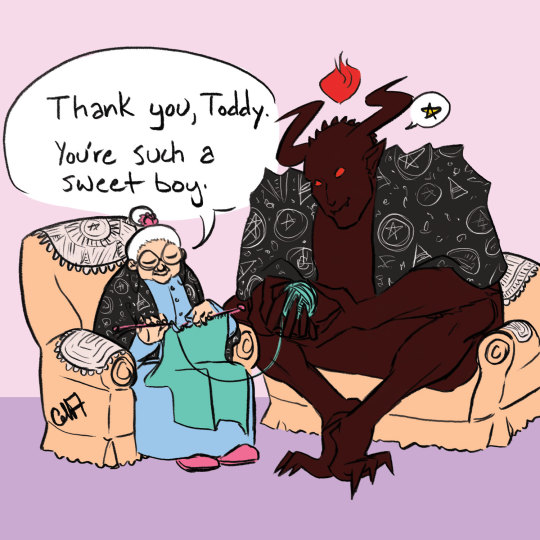
An old and homely grandmother accidentally summons a demon. She mistakes him for her gothic-phase teenage grandson and takes care of him. The demon decides to stay at his new home.
It isn’t uncommon for this particular demon to be summoned—from
exhausting Halloween party pranks in abandoned barns to more legitimate (more
exhausting) ceremonies in forests—but it has to admit, this is the first time
it’s been called forth from its realm into a claustrophobic living room bathed
in the dull orange-pink glow of old glass lamps and a multitude of wide-eyed,
creepy antique porcelain dolls that could give Chucky a run for his money with
all of their silent, seething stares combined. Accompanying those oddities are
tea cup and saucer sets on shelves atop frilly doilies crocheted with the
utmost care, and cross-stitched, colorful ‘Home Sweet Home’s hung across the wood-paneled
walls.
It’s a mistake—a wrong number, per se. No witch it’s ever
known has lived in such an, ah, dated,
home. Furthermore, no practitioner that ever summoned it has been absent, as if
they’d up and ding-dong ditched it. No, it didn’t work that way. Not at all.
Not if they want to survive the encounter.
It hears the clinking of movement in the room adjacent—the kitchen,
going by the pungent, bitter scent of cooled coffee and soggy, sweet sponge
cakes, but more jarring is the smell of blood. It moves—feels something slip
beneath its clawed foot as it does, and sees a crocheted blanket of whites and greys
and deep black yarn, wound intricately, perfectly, into a summoning circle. Its summoning circle. There is a small splash
of bright scarlet and sharp, jagged bits of a broken curio scattered on top,
as if someone had dropped it, attempted to pick it up the pieces and pricked their finger.
It would explain the blood. And it would explain the demon being brought into
this strange place.
As it connects these pieces in its mind, the inhabitant of
the house rounds the corner and exits the kitchen, holding a damp, white dish
towel close to her hand and fumbling with the beaded bifocals hanging from her
neck by a crocheted lanyard before stopping dead in her tracks.
Now, to be fair, the demon wouldn’t ordinarily second guess
being face-to-face with a hunchbacked crone with a beaked nose, beady eyes and
a peculiar lack of teeth, or a spidery shawl and ankle-length black dress, but
there is definitely something amiss here. Especially when the old biddy lets
her spectacles fall slack on her bosom and erupts into a wide, toothy (toothless)
grin, eyes squinting and crinkling from the sheer effort of it.
“Todd! Todd, dear, I didn’t know you were visiting this year!
You didn’t call, you didn’t write—but, oh, I’m so happy you’re here, dear!
Would it have been too much to ask you to ring the doorbell? I almost had a
heart attack. And don’t worry about the blood, here—I had an accident. My favorite
figure toppled off of the table and cleanup didn’t go as expected. But I seem
to recall you are quite into the bloodshed and ‘edgy’ stuff these days, so I
don’t suppose you mind.” She releases a hearty, kind laugh, but it isn’t
mocking, it’s sweet. Grandmotherly. The demon is by no means sentimental or
maudlin, but the kindness, the familiarity, the genuine fondness, does pull a
few dusty old nostalgic heartstrings. “Imagine if it leaves a scar! It’d be a
bit ‘badass,’ as you teenagers say, wouldn’t it?”
She is as blind as a bat without her glasses, it would appear,
because the demon is by no means a ‘Todd’ or a human at all, though humanoid, shrouded
in sleek, black skin and hard spikes and sharp claws. But the demon humors her, if only
because it had been caught off guard.
The old woman smiles still, before turning on her heel and
shuffling into the hallway with a stiff gait revealing a poor hip. “Be a dear
and make some more coffee, would you please? I’ll be back in a jiffy.”
Yes, this is most definitely a mistake. One for the record
books, for certain. For late-night trips to bars and conversations with colleagues,
while others discuss how many souls they’d swindled in exchange for peanuts, or
how many first-borns they’d been pledged for things idiot humans could have
gained without divine intervention. Ugh. Sometimes it all just became so pedantic
that little detours like this were a blessing—happy accidents, as the humans
would say.
That’s why the demon does as asked, and plods slowly into
the kitchen, careful to duck low and avoid the top of the doorframe. That’s why
it gingerly takes the small glass pot and empties it of old, stale coffee and carefully,
so carefully, takes a measuring scoop between its claws and fills the machine
with fresh grounds. It’s as the hot water is percolating that the old woman
returns, her index finger wrapped tight in a series of beige bandages.
“I’m surprised you’re so tall, Todd! I haven’t seen you
since you were at my hip! But your mother mails photos all the time—you do love
wearing all black, don’t you?” She takes a seat at the small round table in the
corner and taps the glass lid of the cake plate with quaking, unsteady, aged hands. “I was starting to think you’d never visit. Your father and I have
had our disagreements, but…I am glad you’re here, dear. Would you like some
cake?” Before the demon has a chance to decline, she lifts the lid and cuts a
generous slice from the near-complete circle that has scarcely been touched. It
smells of citrus and cream and is, as assumed earlier, soggy, oversaturated
with icing.
It was made for a special occasion, for guests, but it doesn’t
seem this old woman receives much company in this musty, stagnant house that
smells like an antique garage that hadn’t had its dust stirred in years.
Especially not from her absentee grandson, Todd.
The demon waits until the coffee pot is full, and takes two
small mugs from the counter, filling them until steam is frothing over the
rims. Then, and only then, does it accept the cake and sit, with some
difficulty, in a small chair at the small table. It warbles out a polite ‘thank
you,’ but it doesn’t suppose the woman understands. Manners are manners
regardless.
“Oh, dear, I can hardly understand. Your voice has gotten so
deep, just like your grandfather’s was. That, and I do recall you have an affinity
for that gravelly, screaming music. Did your voice get strained? It’s alright,
dear, I’ll do the talking. You just rest up. The coffee will help soothe.”
The demon merely nods—some communication can be understood
without fail—and drinks the coffee and eats the cake with a too-small fork. It’s
ordinary, mushy, but delicious because of the intent behind it and the love
that must have gone into its creation.
“I hope you enjoyed all of the presents I sent you. You
never write back—but I am aware most people use that fancy E-mail these days. I
just can’t wrap my head around it. I do wish your mom and dad would visit sometime.
I know of a wonderful little café down the street we can go to. I haven’t been; I wanted to visit it with Charles, before he…well.” She falls silent in her
rambling, staring into her coffee with a small, melancholy smile. “I can’t
believe it’s been ten years. You never had the chance to meet him. But never mind
that.” Suddenly, and with surprising speed that has the demon concerned for her well being, she moves to her feet, bracing her hands on the edge of the table. “I may as
well give you your birthday present, since you’re here. What timing! I only
finished it this morning. I’ll be right back.”
When she returns, the white, grey and black crocheted work with the summoning
circle is bundled in her arms.
“I found these designs in an occult book I borrowed from the
library. I thought you’d like them on a nice, warm blanket to fight off the
winter chill—I hope you do like it.” With gentle hands, she spreads the blanket
over the demon’s broad, spiky back like a shawl, smoothing it over craggy shoulders
and patting its arms affectionately. “Happy birthday, Todd, dear.”
Well, that settles it. Whoever, wherever, Todd is, he’s
clearly missing out. The demon will just have to be her grandson from now on.
this is so sweet. it made me want to hug someone.
i had to
I WOULD WATCH SIX SEASONS AND A MOVIE
Okay but she takes him to the little cafe and all of the people in her town are like “What is that thing, what the hell, Anette?” and she’s like “Don’t you remember my grandson Todd?” and the entire town just has to play along because no one will tell little old Nettie that her grandson is an actual demon because this is the happiest she’s been since her husband died.
Bonus: In season 4 she makes him run for mayor and he wins
I just want to watch ‘Todd’ help her with groceries, and help her with cooking, and help her clean up the dust around the house and air it out, and fill it with spring flowers because Anette mentioned she loved hyacinth and daffodils.
Over the seasons her eyesight worsens, so ‘Todd’ brings a hellhound into the house to act as her seeing eye dog, and people in town are kinda terrified of this massive black brute with fur that drips like thick oil, and a mouth that can open all the way back to its chest, but ‘Honey’ likes her hard candies, and doesn’t get oil on the carpet, and when ‘Todd’ has to go back to Hell for errands, Honey will snuggle up to Anette and rest his giant head on her lap, and whuff at her pockets for butterscotch.
Anette never gives ‘Todd’ her soul, but she gives him her heart
In season six, Anette gets sick. She spends most of the season bedridden and it becomes obvious by about midway through the season that she’s not going to make it to the end of the season. Todd spends the season travelling back and forth between the human realm and his home plane, trying hard to find something, anything that will help Anette get better, to prolong her life. He’s tried getting her to sell him her soul, but she’s just laughed, told him that he shouldn’t talk like that.
With only a few episodes left in the season Anette passes away, Todd is by her side. When the reaper comes for her Todd asks about the fate of her soul. In a dispassionate voice the reaper informs Todd that Anette spent the last few years of her life cavorting with creatures of darkness, that there can be only one fate for her. Todd refuses to accept this and he fights the reaper, eventually injuring the creature and driving it off. Knowing that Anette cannot stay in the Human Realm, and refusing to allow her spirit to be taken by another reaper, so he takes her soul in his arms. He’s done this before, when mortals have sold themselves to him. This time the soul cradled against his chest does not snuggle and fight. This time the soul held tight against him reaches out, pats him on the cheek tells him he was a good boy, and so handsome, just like his grandfather.
Todd takes Anette back to the demon realm, holding her tight against him as he travels across the bleak and forebidding landscape; such a sharp contrast to the rosy warmth of Anette’s home. Eventually, in a far corner of his home plane, Todd finds what he is looking for. It is a place where other demons do not tread; a large boulder cracked and broken, with a gap just barely large enough for Todd to fit through. This crack, of all things, gives him pause, but Anette’s soul makes a comment about needing to get home in time to feed Honey, and Todd forces himself to pass through it. He travels in darkness for a while, before he emerges into into a light so bright that it’s blinding. His eyes adjust slowly, and he finds himself face to face with two creatures, each of them at least twice his size one of them has six wings and the head of a lion, one of them is an amorphous creature within several rings. The lion-headed one snarls at Todd, and demands that he turn back, that he has no business here.
Todd looks down, holding Anette’s soul against his chest, he takes a deep breath, and speaks a single word, “Please.”
The two larger beings are taken aback by this. They are too used to Todd’s kind being belligerent, they consult with each other, they argue. The amorphous one seems to want to be lenient, the lion-headed one insists on being stricter. While they’re arguing Todd sneaks by them and runs as fast as he can, deeper into the brightly lit expanse. The path on which he travels begins to slope upwards, and eventually becomes a staircase. It becomes evident that each step further up the stair is more and more difficult for Todd, that it’s physically paining him to climb these stairs, but he keeps going.
They dedicate a full episode to this climb; interspersing the climb with scenes they weren’t able to show in previous seasons, Anette and Honey coming to visit Todd in the Mayor’s office, Anette and Todd playing bingo together for the first time, Anette and Todd watching their stories together in the mid afternoon, Anette falling asleep in her chair and Todd gently carrying her to bed. Anette making Todd lemonade in the summer while he’s up on the roof fixing that leak and cleaning out the rain gutters. Eventually Todd reaches the top, and all but collapses, he falls to a knee and for the first time his grip on Anette’s soul slips, and she falls away from him. Landing on the ground.
He reaches out for her, but someone gets there first. Another hand reaches out, and helps this elderly woman off the ground, helps her get to her feet. Anette gasps, it’s Charles. The pair of them throw their arms around each other. Anette tells Charles that she’s missed him so much, and she has so much to tell him. Charles nods. Todd watches a soft smile on his face. A delicate hand touches Todd’s shoulder, and pulls him easily to his feet. A figure; we never see exactly what it looks like, leans down, whispering in Todd’s ear that he’s done well, and that Anette will be well taken care of here. That she will spend an eternity with her loved ones. Todd looks back over to her, she’s surrounded by a sea of people. Todd nods, and smiles. The figure behind him tells him that while he has done good in bringing Anette here, this is not his place, and he must leave. Todd nods, he knew this would be the case.
Todd gets about six steps down the stairway before he is stopped by someone grabbing his shoulder again. He turns around, and Anette is standing behind him. She gives him a big hug and leads him back up the stairs, he should stay, she says. Get to know the family. Todd tries to tell her that he can’t stay, but she won’t hear it. She leads him up into the crowd of people and begins introducing him to long dead relatives of hers, all of whom give him skeptical looks when she introduces him as her grandson.
The mysterious figure appears next to Todd again and tells him once more he must leave, Todd opens his mouth to answer but Anette cuts him off. Nonsense, she tells the figure. IF she’s gonna stay here forever her grandson will be welcome to visit her. She and the figure stare at each other for a moment. The figure eventually sighs and looks away, the figure asks Todd if she’s always like this. Todd just shrugs and smiles, allowing Anette to lead him through a pair of pearly gates, she’s already talking about how much cake they’ll need to feed all of these relatives.
P.S. Honey is a Good Dog and gets to go, too.
the last lines of the show:
demon: you’re not blind here – but you’re not surprised. when…?
anette: oh, toddy, don’t be silly, my biological grandson’s not twelve feet tall and doesn’t scorch the furniture when he sneezes. i’ve known for ages.
demon: then why?
anette: you wouldn’t have stayed if you weren’t lonely too.
demon: you… you don’t have to keep calling me your grandson.
anette: nonsense! adopted children are just as real. now quit sniffling, you silly boy, and let’s go bake a cake. honey, heel!
yeah, yeah I know I already reblogged “autobiography” earlier today which is basically about a thousand times more exactly what I want to say than any essay could possibly be BUT then I went and actually read what people are arguing here and you know what
SOOOOOOOO
There are two things that are being collapsed in this argument that we really, really cannot afford to collapse. That is:
For AO3 to be a sustainable project long-term, there needs to be a comprehensive policy in place designed to prevent its users from harassment and abuse; and
Some content that people would like to host on AO3 is, to some people, vile or offensive.
Both of these things are true. However, it does not follow from (1) that we need to regulate or restrict the content of the works hosted on the Archive to ensure the content referred to in (2) doesn’t make it onto the Archive. People seem to be taking it for granted that (1) means banning all that stuff in (2), and that’s wrong.
(cw for high-level references to the existence of rape, underage sex, and anti-Semitism; as well as one marginally more specific reference to kinky sex)
Once upon a time there was a beast and a curse and an enchantress, which I’m sure surprises nobody. Better put it this way: once upon a time a girl was locked in a castle, and she begged so hard not to be the sleeping princess that she became the beast. That’s more like it, anyway — fairytale logic. You get what you wish for, but it isn’t what you want.
“Don’t let it be a prince,” she begged, “don’t let it be a kiss I can’t see coming and can’t refuse.”
Enchantresses, wicked fairies, call them what you will — they’re all the same story in the end. No one will remember if this enchantress began the story by giving the princess a naming day gift of a hundred year sleep once the tale switches to another track. The point is that she didn’t mind granting this one favor. Maybe it was an issue of statistics. Maybe she thought finding a girl who would fall in love with a princess-beast would be harder than finding a prince to kiss her, make her curse harder to lift (considering the probabilities of who might wander onto the cursed castle grounds). As if girls who love girls don’t know they have to fight harder to begin with, as if they won’t cross miles for each other.
So maybe there was a spindle once, but now there is a rose, and a girl who wanders through a thorn maze unable to find her way. This is the wrong story, she thinks to herself, clutching her leather satchel tighter, but she doesn’t know what the right story is.
“Let me through?” She suggests to the roses that grow squeezed between their own thorns along the twisting hedges. “I’m looking for the love of my life. I’m in a hurry.”
She’s met only with the rustling of leaves and haughty scoffs. “No prince ever found his true love by being in a hurry.”
“I’m not a prince. I’m a shoemaker, and I’m lost. Can you let me through to the castle?” It rises dark and spindly overhead, but though it seems so close she can see no way out of the maze.
Laughter, echoing through the hedge corridors, and then something dark prowls around the corner and half-crouches there, hidden as much as possible under a hooded cloak. Shining talons dig into the earth under their feet.
The beast says, “A shoemaker? You really are in the wrong story.” Her voice is gravely and doesn’t match the laughter. That must have been the roses as well.
“I have glass shoes,” the girl says, staring at those claws. “Or I can make something sturdier, if you give me time.”
“I don’t have enough time of my own to be giving it away,” the beast says, bored, and gestures around them. Even now the hedges seem to be encroaching further into the maze’s corridors, the roses growing and multiplying. One day soon, the girl realizes, the maze will entirely fill in, and the castle will be blocked off.
She’s clever, and she’s brave, and those are the two most important things for a fairytale heroine to be — besides pretty, but that’s easy enough to fake with the right kind of smile. “Then don’t give it to me,” she says, “we can share.”
So the beast reaches out one arm, fingers tapering into knives that she curls so gently they don’t more than scratch the girl’s skin — and the shoemaker takes it with an earnest gravity, looking right under her cloak’s shadow and into her eyes.
The beast’s eyes are unnaturally big and inhumanly shaped, but they’re not cruel, and in fairytales the evil beasts always have cruel eyes. The girl bobs a polite curtsey, using the beast’s arm for balance, and sees those eyes narrow slightly with amusement.
They walk through the twists and turns of the maze to the castle, the beast bent slightly so as not to tower over her guest. “About those shoes,” she says, when they reach the front doors, golden light spilling from the entrance hall and shining through the delicately carved details in the ancient wood.
“In the morning,” the girl says, and because she clearly has not even entertained the thought that she might be argued with, the beast cannot summon an objection. She watches the girl follow an unfurling carpet along the floor to a dusty guest room with no hesitation, as if every dwelling should be as accommodating.
And in the way of fairytales, that’s enough to make the beast fall in love — a disregard for every unspoken rule, a smile that glimmers in the darkness. Should I tell you that the moment the girl arrives at breakfast the next morning the beast can barely look away from her for a moment, that she stays by the girl’s side as she produces leather and tools from nowhere and searches floor by floor for the perfect room to work in — or should I let you imagine for yourself?
Gradually the hood is pulled back, eventually the cloak discarded altogether; they sit in patches of sunlight together to eat lunch, staring down at the maze below. Roses and leaves devouring each other and everything in slow motion.
“If you stay too long you’ll be trapped here,” the beast warns, anxious when the girls shows no concern in her usual solemn air as she watches the maze devolve.
“I haven’t finished your shoes,” is all she says. Each new morning she promises that in return for this latest night of hospitality she is making the shoes more beautiful, and each evening that she has not finished she stays another night.
Sometimes when the girl has gone to bed the beast sneaks back into the workroom, in agony over whether to rip out the stitches or finish the work for her.
Leave before you are trapped here forever.
Stay here forever because I love you.
Each night she does not touch the shoes and returns to sleep herself, and in the morning the girl thanks her for letting her stay, as if the beast could ever turn her out, and promises to repay the night with even more beautiful shoes.
And each morning the beast says, “That’s fair,” and wishes she could find different words, the words she means to say.
The maze grows. The roses are larger than hands with fully spread fingers. The corridors are barely large enough for a small girl to squeeze through. In the dawn light it is lit gently and slightly pink, but the sight of it is painful. The wide window of the workroom shows the progress the maze had made alarmingly clearly, and it’s only then that the beast wonders if that was the appeal of this room over all the others.
The girl appears silently in the doorway as she has for the past week. “Thank you for letting me stay last night. I’ll repay you—”
“No,” the beast says, her voice alarmed and rough. “No. You are leaving now.”
“Now?”
“Before you can’t leave. You must go now.” Her throat is closing up and her voice growing thicker with each word. They’re not the words she wants to say.
The girl cocks her head, a curiously nonjudgmental silence. Finally she crosses the room to her worktable and picks up the shoes, turning them around and around again. They’re boots, really, and almost comically big in her hands. The beast cannot tell if they are as beautiful as she was promised, because the girl is smiling now and that eclipses all else.
“Are they finished?” She asks.
“Yes,” the beast says, unable to choke out anything more.
The girl leaves the boots on the table and swings her satchel, out of nowhere, across her shoulders. “Thank you for sharing your time,” she says. For a moment she holds the beast’s hand in both of hers, and then she’s gone. From the window the beast can watch her leave; for all her trouble getting there, she finds her way out with ease.
She leaves the workroom and doesn’t return all day.
Do beasts grieve? She hadn’t thought they could. She hadn’t grieved when the curse was settled on her; she hadn’t grieved at the idea that it might never lift once the maze finally knit itself together during the coming night. But the loneliness she feels now was different. The absence of the shoemaker is something worse. She’d had no choice in her fate, but she had told the girl to leave. This misery she’d brought on herself.
At night she wanders back into the workroom out of habit, sleepless and hopeless and refusing to glance out the window. Has it happened yet? Is she truly trapped now, or will it happen in five minutes, an hour, at dawn? She stares at the boots for an indeterminable amount of time before she thinks of putting them on.
She does so only because she thinks the girl wanted her to wear them; left to her own devices she might have destroyed them with as little thought as she now gives to slipping them on. They are big enough, and the fasteners are easy to close even with her unwieldy claws. Designs etched into the leather yet invisible in the darkness spiral and branch out beneath the thumb-pad she runs over them. Vines, she thinks. Roses.
A tear slips out, or three, as she stands in her beautiful new boots and smells leather and rotting roses. I want her back, she thinks, even as a wave of thankfulness rises up from the deepness in her, thankfulness that the shoemaker will never feel this trapped. I want to go to her, she revises. Since she doesn’t know how, she goes to leave the workroom instead.
One step and darkness is rushing past her. The rough scrap of stone walls, the rustle of leaves and the tearing of thorns, night air soft all around her. She has stepped not into the hallway but out of the castle, beyond the maze, into the star-dappled night.
“What did you do?” She asks, alarmed, almost before she sees the shoemaker sitting cross-legged on the grassy hill, as still as if she has been waiting all day and night. “What happened?”
“I found what I came for,” the girl says calmly. “And I made her shoes.”
“As if girls who love girls don’t know they have to fight harder to begin with, as if they won’t cross miles for each other.



 Question of Smoke