idk I just love how we Young People Today use ~improper~ punctuation/grammar in actually really defined ways to express tone without having to explicitly state tone like that’s just really fucking cool, like
no = “No,” she said.
no. = "No,” she said sharply.
No = “No,” she
stated
firmly.
No. = “No,” she snapped.
NO = “No!” she shouted.
noooooo = “No,” she moaned.
no~ = “No,” she said with a drawn-out sing-song.
~no~ = “No,” she drawled sarcastically.
NOOOOO = “No!” she screamed dramatically.
no?! = “No,” she said incredulously.
I’ve been calling this “typographical nuance” and I have a few more to add:
*no* = “No,” she said emphatically.
*nopes on out of here* = “No,” she said of herself in the third person, with a touch of humorous emphasis.
~*~noooo~*~ = “No,” she moaned in stylized pseudo-desperation.
#no = “No,” she added as a side comment.
“no” = “No,” she scare-quoted.
wtf are you kidding no = “No,” she said flatly. “And I can’t believe I have to say this.”
no no No No NO NO NO NO = "No,” she repeated over and over again, growing louder and more emphatic.
nooOOOO = “No,” she said, starting out quietly and turning into a scream.
*no = “Oops, I meant ‘no,’” she corrected, “Sorry for the typo in my previous message.”
I cannot express how strongly I absolutely love language and writing and communication but if anyone asks why I will be showing them this post from now on
this is great, but I got to “no no No No NO NO NO NO” and immediately started singing “mamma mia, mamma mia, mamma mia let me go”
no no no nO (no no no)= “No,” she said, sticking to the status quo
Me 10 years ago: I never use online abbreviations! standard english all the time!
Me a couple of years ago: u kno wat fuck it
Me now: it is impossible to communicate effectively online without using internet slang due to the mixed mode format and lack of paralinguistic features. Things like lack of punctuation, abbreviations, acronyms and such all have their own connotations and communicate far more than their commonly accepted meaning. Linguistics has evolved. n u kno what i love it
Synonyms are weird because if you invite someone to your cottage in the forest that just sounds nice and cozy, but if I invite you to my cabin in the woods you’re going to die.
My favourite is explaining the difference between a butt dial and a booty call
as a welsh person i want you all to accept that W is a vowel because honestly it makes pronouncing acronyms so much easier. wlw becomes ‘ooloo’, wjec becomes ‘oojeck’, love yourselves and stop giving us shit when we tell you welsh has 7 vowels. english actually has 15 vowel sounds but because y’all only use 5 letters you have to rely on a spelling system devised by satan
and please, enough with the “keyboard smashing” jokes. not original, not funny.
yeah, we can actually because the spelling is phonetic. meanwhile english folks have placenames like bicester or keighley or beaulieu, which you have to learn the pronunciation for individually because the rules are so inconsistent. i mean people can’t even agree how to pronounce marylebone but sure welsh place names are the weird ones
fun fact: welsh orthography is actually easy to read if you take your head out of your arse for one minute and learn our alphabet – just like french, or spanish, or korean, because surprise! languages use different spelling systems that are not based on english. novel, i know – and in the 18th century, travelling schools were able to teach people to read and write welsh in a matter of months, so that wales enjoyed a literate majority, a rare thing in europe at the time
fun fact: the english have been taking the piss out of welsh for years, just like they’ve been doing for irish, and scots gaelic, and cornish, and british sign language, and a hundred and one other languages, because evidently the fact that the whole world isn’t anglophone and monocultured and Still Part Of The Empire is a problem, and something that needs to be corrected
(quietly cheers in support of the Welsh, and your language sounds beautiful, too)
drag them, wales!
Go Wales
the thing people need to get through their heads is what the original statement is:
W is a vowel, and LL and FF are single letters not two Ls or two Fs. Saying LL is two letters is as dumb as saying W is two letters just because it looks like two Vs.
We have a different alphabet, it just looks a lot like the english one.
Welsh is, in addition, one of the oldest surviving indo-European languages. It dates back as far as 4,000 years and is one of the few surviving Celtic languages.
WRONG. It can still be seen as queerbaiting the audience if the character or ship in question only exists as a token, and then is ultimately erased from the story for shock value in a way that suggests expressing who they are has consequences. Ever heard of Clexa?
thank you for allowing me this opportunity to expand on my point at length, because i’m not wrong.
fandom has existed for a very long time. it is its own culture, with its own customs and behaviours and language. this last one, language, is the key issue i want to focus on here, because fandom has its own language, just like any other culture. and that means that, just like all other cultures, language shifts, evolves, and outright changes.
what that doesn’t mean is that, without intention, terms WITH AN ESTABLISHED MEANING are used to mean something completely different. shifts in meaning occur for a lot of reasons, but there IS A REASON. that reason might be humour, it might be ignorance, it might be education, it might be that the concept a word encompasses expands.
“queerbaiting” didn’t originate in fandom. the word was first used to describe members of the police force “baiting” gay men into revealing themselves as queer by indicating they were available for sexual activity, only to arrest the men once they had indicated they were interested. this is a pretty specific scenario that has obvious connection to the components of the word itself.
fandom had adopted this term by at least the late 90s as a pretty direct transposition of the entire scenario being described. in the place of police we have media creators, but the idea was still the same: engaging in conduct meant to lead queer people to believe the media was queer.
the issue of what conduct constitutes queerbaiting is heavily debated, but the end point remains the same: the media was only meant to make viewers THINK it was queer, without ever making it explicit.
now. when you are talking about doing something to make queer (or queer-interested) people watch your media, queerbaiting as described above obviously falls within that “something” category. but so does having actual queer characters. and if we start using the term queerbaiting to encompass the entire concept of attracting queer (-interested) viewers, you lose all nuance as to the ways in which people tend to fuck us over.
what’s happening with queer women on television at the moment is fucking atrocious, and it deserves to be loudly decried as publicly as possible. but when i level accusations of fucking me over at shows like rizzoli and isles or once upon a time, i absolutely do not want to conflate that with shows murdering their queer characters. because that is way fucking worse, to be honest, and it should explicitly be called out as such. adopting the term queerbaiting here not only has the effect of diminishing the harm done by those who engage in it as defined above, but it muddies the actual issue of concern. it doesn’t matter that they made us watch, it matters that they keep murdering us, whether we’re watching or not.
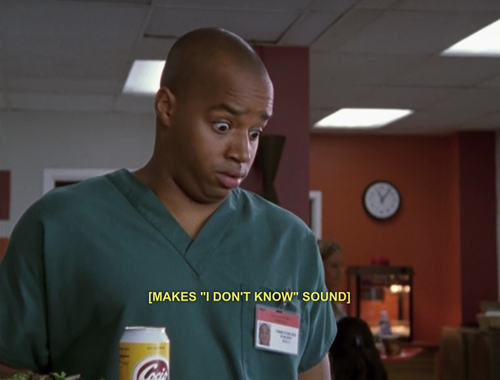
You know what I think is really cool about language (English in this case)? It’s the way you can express “I don’t know” without opening your mouth. All you have to do is hum a low note, a high note, then another lower note. The same goes for yes and no. Does anyone know what this is called?
These are called vocables, a form of non-lexical utterance – that is, wordlike sounds that aren’t strictly words, have flexible meaning depending on context, and reflect the speakers emotional reaction to the context rather than stating something specific. They also include uh-oh! (that’s not good!), uh-huh and mm-hmm (yes), uhn-uhn (no), huh? (what?), huh… (oh, I see…), hmmn… (I wonder… / maybe…), awww! (that’s cute!), aww… (darn it…), um? (excuse me; that doesn’t seem right?), ugh and guh (expressions of alarm, disgust, or sympathy toward somebody else’s displeasure or distress), etc.
Every natural human language has at least a few vocables in it, and filler words like “um” and “erm” are also part of this overall class of utterances. Technically “vocable” itself refers to a wider category of utterances, but these types of sounds are the ones most frequently being referred to, when the word is used.
Reblog if u just hummed all of these out loud as you read them
 Question of Smoke