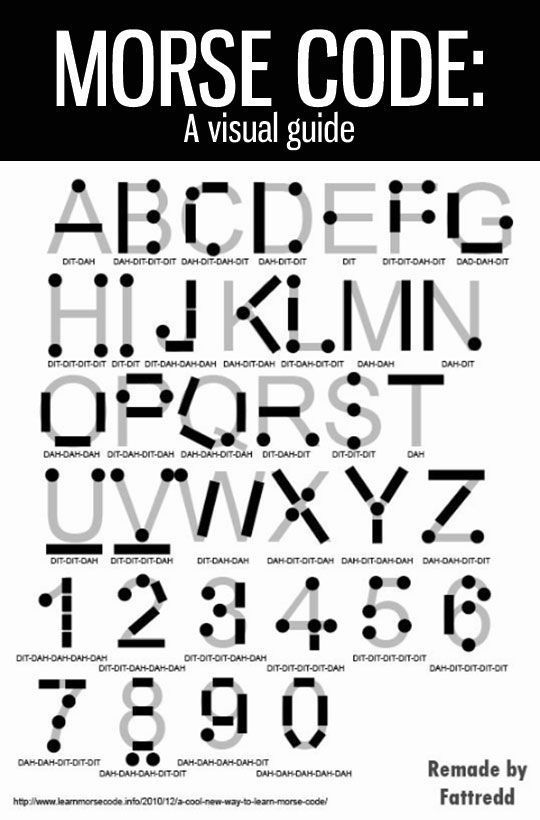
Oh oh my god now Morse code actually makes SENSE when you lay it out like that
Awesome!!
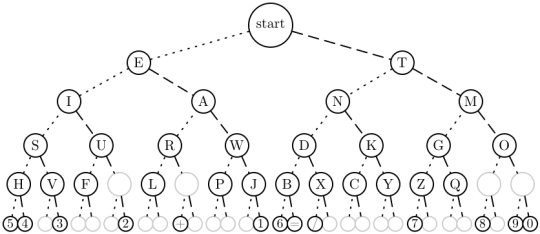
This is also nice, if you want to decode morse code quickly.
that avl tree though
That’s not a coincidence! Naturally, it’s less work to transmit shorter sequences of dots and dashes, so we try to use up all the shorter sequences first. Basically, this means that we fill in all the branches at one level of this tree before moving onto the next. The result is a perfectly balanced decoding tree.
The placement of the letters is also far from arbitrary. Here are all the letters in English ordered from most common to least common:
ETAOINSRHLDCUMFPGWYBVKXJQZ
Notice something? The shortest morse code sequences were assigned to the most common letters. This makes the common letters easier to remember, and makes messages as short as possible in the average case.
Numbers are sort of an exception to this. All numerical symbols are encoded with 5 dots and dashes. But there’s a pretty clear pattern to these as well.
1 = .—-
2 = ..—
3 = …–
4 = ….-
5 = …..
6 = -….
7 = –…
8 = —..
9 = —-.
0 = —–
So if the listener hears a series of 5 dots and dashes, they immediately know it’s a number. To decode it, they count the number of dashes. If the dashes came before the dots, the number is 5 + the number of dashes. Otherwise, the number is 5 – the number of dashes.
A REAL LIST OF ACTUAL NAMES AND THEIR (approximate) PRONUNCIATIONS: Siobhan — “sheh-VAWN” Aoife – “EE-fa” Aislin – “ASH-linn”
Bláithín – “BLAW-heen”
Caoimhe – “KEE-va”
Eoghan – Owen (sometimes with a slight “y” at the beginning)
Gráinne – “GRAW-nya”
Iarfhlaith – “EER-lah” Méabh – “MAYV” Naomh or Niamh – “NEEV” Oisín – OSH-een or USH-een Órfhlaith – OR-la Odhrán – O-rawn Sinéad – shi-NAYD Tadhg – TIEG (like you’re saying “tie” or “Thai” with a G and the end)
I work with an Aoife and I have been pronouncing it SO WRONG
As someone who is trying and failing to learn Gaelic, I feel like is an accurate portrayal of my pain.
This is the Anglicized spelling of a people who really fucking hate the English.
No, no, this is the orthographic equivalent of installing Windows on Mac.
The Latin alphabet was barely adequate for Latin by the time it got to the British Isles, but it’s what people were writing with, so somebody tried to hack it to make it work for Irish. Except, major problem: Irish has two sets of consonants, “broad” and “slender” (labialized and palatalized) and there’s a non-trivial difference between the two of them. But there weren’t enough letters in the Latin alphabet to assign separate characters to the broad and slender version of similar sounds.
Instead, someone though, let’s just use the surrounding vowels to disambiguate–but there weren’t enough vowel characters to indicate all the vowel sounds they needed to write, so that required some doubling up, and then adding in some silent vowels just to serve as markers of broad vs. slender made eveything worse.
They also had to double up some consonants, because, for example, <v> wasn’t actually a letter at the time–just a variation on <u>–so for the /v/ sound they <bh>. AND THEN ALSO Irish has this weird-ass system where the initial consonant sound in a word changes as a grammatical marker, called “mutation,” so they had to account somehow for mutated sounds vs. non-mutated sounds, which sometimes meant leaving a lot of other silent letters in a word to remind you what word you were looking at.
And then a thousand years of sound change rubbed its dirty little hands all over a system that was kind of pasted together in the first place.
My point is, there is a METHOD to the orthography of Irish besides “fuck the English.” The “fuck the English” part is just a delightful side-effect.
It’s not just ‘mom’ vs ‘mum’, that’s just a very easy example to use. But I’ll explain my issue with it anyway.
To me, it’s about respect.
I am from the UK. Words like Mom, Sidewalk, Diaper, Shopping Cart, etc are NOT parts of my vocabulary. They are not words I use, and if I did, I’d get mercilessly teased for it, because we’re not American.
HOWEVER!
A lot of the characters that I write for, they ARE American. So they’d say and think those words. I respect that. I respect that the creators were likely American. I respect that the people reading it are probably going to be American. I respect that American’s have wrong different words for things. So I use those words.
I go out of my way to use words that are not in my vocabulary, to make sure that what I’m writing is authentic and correct. I once spent 5 minutes trying to figure out what American’s call Shopping Trolleys (Carts. You call them Carts.) because I knew you didn’t call them Trolleys like we do. Every British friend of mine does the Exact. Same. Thing.
Now!
Most fandoms, really, are American. If you check the fandom list in my bio, other than one character in Overwatch, and SNK, they’re all American. Meaning that the fanfictions I write are mostly for American Fandoms. Any gifsets I’d make (if I ever gain that skill) will be for American Fandoms. Etc, etc, you see my point?
The 3 big British Fandoms are Harry Potter, Doctor Who and Sherlock. I’ll be disregarding Sherlock, because I’m not part of that fandom.
I’ve read a few Doctor Who and Harry Potter fics and every time I see that the writer hasn’t taken the time to learn British English (Or get a British BETA reader who can catch these mistakes) it almost instantly makes the fic unreadable.
Ron Weasely would not be calling Molly ‘Mom’. He’d call her ‘Mum’. They are British. The Doctor wouldn’t be talking about getting a ‘Pacifier’ for Melody Pond, he’d talk about a ‘Dummy’.
Yes, it is a minor thing. Which makes it all the more frustrating. It will never take long to make sure you’re using the correct language for the version of English your characters would be speaking. Or, if you REALLY don’t want to learn, find a British Person who will BETA read. (I’ve had friends that have done this for Sherlock fanfiction. They’ll BETA read the whole fic, but the main aim is to correct Americanisms into Britishisms.) It’s not like you’re being asked to learn a whole new language, just slightly edit the one you already speak to make it authentic.
So I really do not want to be that person, however one of the things that some times gets lost is regional dialects. For example, in the south east continental US a cart is often called a buggy. In some parts of he country it is soda, in others pop and in Kentucky and Tennessee it’s Cola.
I get that, regional dialects are often lost and I can imagine that’s pretty freaking irritating too.
If I knew a character was from a particular place, I’d do my best to figure out their dialects.
It’s just the lack of respect that bothers me. Just… Do your research, it’s not gonna take you more than a few minutes!
I’m ageeing with you. I have friends from very where with so many lexicons that I get annoyed when characters all have the same voice.
old people really need to learn how to text accurately to the mood they’re trying to represent like my boss texted me wondering when my semester is over so she can start scheduling me more hours and i was like my finals are done the 15th! And she texts back “Yay for you….” how the fuck am i supposed to interpret that besides passive aggressive
Someone needs to do a linguistic study on people over 50 and how they use the ellipsis. It’s FASCINATING. I never know the mood they’re trying to convey.
I actually thought for a long time that texting just made my mother cranky. But then I watched my sister send her a funny text, and my mother was laughing her ass off. But her actual texted response?
“Ha… right.”
Like, she had actual goddamn tears in her eyes, and that was what she considered an appropriate reply to the joke.I just marvelled for a minute like ‘what the actual hell?’ and eventually asked my mom a few questions. I didn’t want to make her feel defensive or self-conscious or anything, it just kind of blew my mind, and I wanted to know what she was thinking.
Turns out that she’s using the ellipsis the same way I would use a dash, and also to create ‘more space between words’ because it ‘just looks better to her’. Also, that I tend to perceive an ellipsis as an innate ‘downswing’, sort of like the opposite of the upswing you get when you ask a question, but she doesn’t. And that she never uses exclamation marks, because all her teachers basically drilled it into her that exclamation marks were horrible things that made you sound stupid and/or aggressive.
So whereas I might sent a response that looked something like:
“Yay! That sounds great – where are we meeting?”
My mother, whilst meaning the exact same thing, would go:
‘Yay. That sounds great… where are we meeting?”
And when I look at both of those texts, mine reads like ‘happy/approval’ to my eye, whereas my mother’s looks flat. Positive phrasing delivered in a completely flat tone of voice is almost always sarcastic when spoken aloud, so written down, it looks sarcastic or passive-aggressive.
On the reverse, my mother thinks my texts look, in her words, ‘ditzy’ and ‘loud’. She actually expressed confusion, because she knows I write and she thinks that I write well when I’m constructing prose, and she, apparently, could never understand why I ‘wrote like an airhead who never learned proper English’ in all my texts. It led to an interesting discussion on conversational text. Texting and text-based chatting are, relatively, still pretty new, and my mother’s generation by and large didn’t grow up writing things down in real-time conversations. The closest equivalent would be passing notes in class, and that almost never went on for as long as a text conversation might. But letters had been largely supplanted by telephones at that point, so ‘conversational writing’ was not a thing she had to master.
So whereas people around my age or younger tend to text like we’re scripting our own dialogue and need to convey the right intonations, my mom writes her texts like she’s expecting her Eighth grade English teacher to come and mark them in red pen. She has learned that proper punctuation and mistakes are more acceptable, but when she considers putting effort into how she’s writing, it’s always the lines of making it more formal or technically correct, and not along the lines of ‘how would this sound if you said it out loud?’
One of Washoe’s caretakers was pregnant and missed work for many weeks after she miscarried. Roger Fouts recounts the following situation:
“People who should be there for her and aren’t are often given the cold shoulder—her way of informing them that she’s miffed at them. Washoe greeted Kat [the caretaker] in just this way when she finally returned to work with the chimps. Kat made her apologies to Washoe, then decided to tell her the truth, signing “MY BABY DIED.” Washoe stared at her, then looked down. She finally peered into Kat’s eyes again and carefully signed “CRY”, touching her cheek and drawing her finger down the path a tear would make on a human (Chimpanzees don’t shed tears). Kat later remarked that one sign told her more about Washoe and her mental capabilities than all her longer, grammatically perfect sentences.“ [23]
Washoe herself lost two children; one baby died shortly after birth of a heart defect, the other baby, Sequoyah, died of a staph infection at two months of age.
more about Washoe:
after the death of her children, researchers were determined to have Washoe raise a baby and brought in a ten month chimpanzee named Loulis. one of the caretakers went to Washoe’s enclosure and signed “i have a baby for you.” Washoe became incredibly excited, yelling and swaying from side to side, signing “baby” over and over again. then she signed “my baby.”
the caretaker came back with Loulis, and Washoe’s excitement disappeared entirely. she refused to pick Loulis up, instead signing “baby” apathetically; it was clear that the baby she thought she was getting was going to be Sequoyah. eventually Washoe did approach Loulis, and by the next day the two had bonded and from then on she was utterly devoted to him.
*information shamelessly paraphrased from When Elephants Weep by Jeffrey Masson.
Even more interestingly, after Washoe and Loulis bonded, she started teaching him American Sign Language the same way that human parents teach their children language. It only took Loulis eight days to learn his first sign from Washoe, and aside from the seven that his human handlers learned around him, he learned to speak in ASL just as fluently as Washoe and was able to communicate with humans in the same way she could.
now if y’all don’t think this is the tightest shit you can get outta my face
things english speakers know, but don’t know we know.
WOAH WHAT?
That is profound. I noticed this by accident when asked about adjectives by a Japanese student. She translated something from Japanese like “Brown big cat” and I corrected her. When she asked me why, I bluescreened.
Synonyms are weird because if you invite someone to your cottage in the forest that just sounds nice and cozy, but if I invite you to my cabin in the woods you’re going to die.
My favourite is explaining the difference between a butt dial and a booty call
 Question of Smoke