ironykins:

goldendragon22:

ironykins:

eurotrottest:

sammiwolfe:

coyotecomforts:

love-this-pic-dot-com:

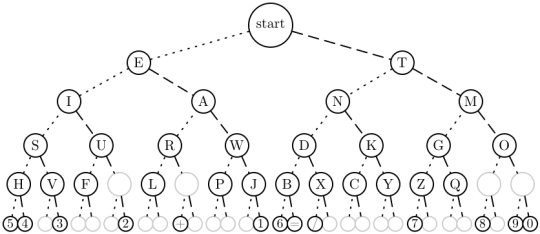
Morse Code A Visual Guide

sammiwolfe important to our lives lol XD

Oh oh my god now Morse code actually makes SENSE when you lay it out like that

Awesome!!

This is also nice, if you want to decode morse code quickly. 

that avl tree though

That’s not a coincidence! Naturally, it’s less work to transmit shorter sequences of dots and dashes, so we try to use up all the shorter sequences first. Basically, this means that we fill in all the branches at one level of this tree before moving onto the next. The result is a perfectly balanced decoding tree. 

The placement of the letters is also far from arbitrary. Here are all the letters in English ordered from most common to least common: 

ETAOINSRHLDCUMFPGWYBVKXJQZ

Notice something? The shortest morse code sequences were assigned to the most common letters. This makes the common letters easier to remember, and makes messages as short as possible in the average case.

Numbers are sort of an exception to this. All numerical symbols are encoded with 5 dots and dashes. But there’s a pretty clear pattern to these as well. 

1 = .—-

2 = ..—

3 = …–

4 = ….-

5 = …..

6 = -….

7 = –…

8 = —..

9 = —-.

0 = —–

So if the listener hears a series of 5 dots and dashes, they immediately know it’s a number. To decode it, they count the number of dashes. If the dashes came before the dots, the number is 5 + the number of dashes. Otherwise, the number is 5 – the number of dashes. 

Morse Code is neat.

vague-humanoid:

muchymozzarella:

The thing about how women in comics used to be drawn and sometimes are still drawn, you can only really understand the difference between an action girl being forced into unrealistic sexual, sensual positions, and an actual strong and well posed, empowering but still sexy female character, when you see what it looks like to have male characters depicted in overtly sensual poses

And I’m not talking about the Hawkeye Initiative or any given parody

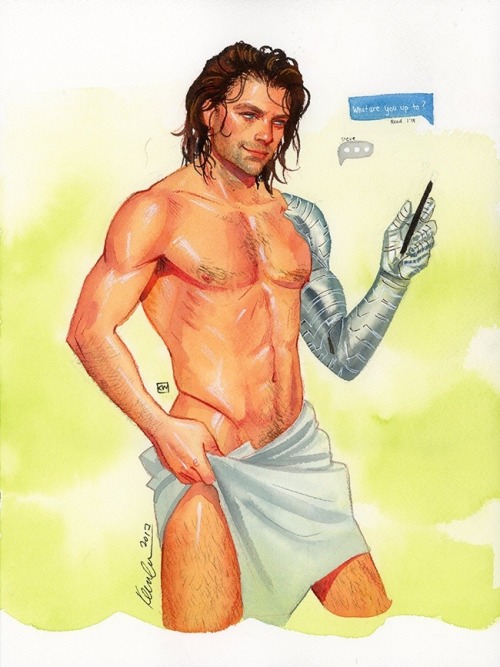
I actually want to draw a comparison using art by Kevin Wada

Kevin Wada is a proud part of the LGBTQ+ community and he has this unique ability to sexualize mainstream male heroes without it looking like a parody. He draws covers for multiple big comic companies and his style reminiscent of old fashion magazines, drawn largely in traditional watercolor, has made him a stalwart of the industry.

He also draws a lot of naked Bucky Barnes.

Anyway, I want to talk about how interesting his art is, the difference between his power poses and his sexy poses for male and female characters.

A typical power pose for a male comics character would look like this

Whereas every so often with female heroes you get something like this

Not all the time, of course, but it happens and it happens in the wrong places. You wouldn’t be posing like a cover model in the middle of a battle, you really wouldn’t.

But when it comes to Wada and male and female characters, the difference is pretty clear.

When he draws male characters, they more often look like this

Sensual, in a pose you wouldn’t usually see a big, muscular hero doing. If not that, then playful, sexy, for looking at, but nothing about their anatomy overly exaggerated

How he draws women is also very clearly different from many other artists, from sexy pose to power pose.

Still posing for the camera, still to be looked at, but very, very different from how we’ve seen female characters portrayed in mainstream comics in the past.

And I guess it’s really just a matter of variety? Objectification in art is a long time debate and appears everywhere always, but for all that we can argue about its impact on popular media, there are a few things I know for sure:

1) having a female character pose like a playboy cover girl in the middle of a battle scene is just Bad Art and y’all need to find better references

2) female power poses will never look quite as right as when they’re drawn by people who know the value of expressing personality through pose (it’s basic animation principles and some artists still need to learn it) and who actually know what a female character’s personality beyond “sexy”

3) Iron Man or Batman posing like they’re about to beat somebody up is 100% not the same as a fashion drawing by Kevin Wada where a Typical Beefy Action Guy gets to pose like a flirty pretty boy

4) the MCU films have figured out the value of pandering to female audiences by sexually objectifying all their male action heroes while simultaneously appealing to the male demographic’s action movie power fantasy. Quoting Chris Hemsworth and Taika Waititi: “I’m not a piece of meat” “Uh, yes you are.”

They definitely struck some kind of balance there.

Also, more important than this entire post: y’all should follow @kevinwada on Tumblr and give him love because his art is divine and his talent beyond words

@luftbian

argyle-s:

dhaskoi:

When it
happens it happens fast.  The story about Lena’s illegal activities leaks
online first – a blog run by a disenfranchised L-corp employee who was shocked
to discover the company she works for is spending a fortune to develop
technology seemingly designed to kill the superhero who once saved her
life.  Lena did the science on her own, but the amount of money she
spent making the kryptonite couldn’t stay hidden forever.  Lena and James
are in full damage control mode.  Kara is panicking and conflicted by the
tone of the coverage – people are laying into Lena in defence of *her*,
supergirl, furious at what they perceive as another Luthor up to the same old
tricks, threatening their hero.

‘Lena’s
my friend’ she wants to say.  ‘She’s not a bad person.‘  Except Lena
did do all the things they’re angry about and their reasons for being angry
seem valid.  Kara’s left with an uneasy feeling that she’s missing
something.

Cat sees
the stories within an hour of the original leak.  Her response is immediate. 
After a long conversation with Olivia and a hasty search for a replacement Cat
hands in her resignation and takes a private flight back to National City,
networking all the way.  By the time her flight lands there’s an emergency
board meeting scheduled for the next day, one that James and Lena don’t know
anything about.  They’re surprised to see her, then furious.  The
terms under which Lena was allowed to purchase a controlling interest in a
multi billion dollar company so cheaply are quite clear – provided Cat has the
money and isn’t in public service she can claim them back any time she likes –
but that doesn’t prevent Lena from trying to stop the buy back.  The
meeting gets ugly, but Cat doesn’t give her a choice and the board is on side. 
They don’t all love her, but they like Cat (and the power of her brand, not
exactly weakened by a stint as the WHPS) a lot better than a young and untried
CEO who seems to treat the company as a hobby.
Especially when that CEO is being investigated by the FBI.

Because
the feds weren’t just sitting around while all this is happening.  Lena Luthor has possibly broken a bunch of
federal laws and the DEO has apparently dropped the ball on investigating
her.  The FBI are already opening a case
file.

Lena
doesn’t seem to know how to handle someone who simply refuses to let her
browbeat or guilt trip them into submission.  Is that why she signed the
contract, Cat wonders?  Did she think she could get her own way just by
complaining?  Lena claims prejudice against Luthors.  Cat points out
that it’s not prejudicial to be investigated for breaking the law when there’s
quite a lot of evidence that you did, in fact, break the law. When the meeting
gets out Kara is there, wide eyed and pale faced and Cat wishes, badly, that
she had time to stop and explain, but she doesn’t.  There’s a lot that
needs to be done and it needs to be done fast.

Her next
meeting is with James.  Olsen is all pride and self-importance, clearly
thinking this is an opportunity to badger her about the short sharp way she’s
just dealt with Lena.  She expected so much better from him than this.

“You’re
fired,” Cat tells him.

There’s
yelling, all the usual words men call women who have power over them.

Cat has
some things to say about people who run media conglomerates not reporting major
stories.  Such as, for example, a powerful billionaire having secretly and
illegally made their own stockpile of kryptonite with misappropriated funds and
having lied during a criminal investigation.  There are also the illegal,
unethical, unauthorised medical experiments (with no actual doctor involved)
said not-so-hypothetical billionaire was running.  And James knew about it
and didn’t report it.

It didn’t
even occur to him that he should report it, Cat observes.  He’s so far
gone there wasn’t even an ethical struggle.  Is it because Lena was his
boss or his girlfriend?  She doesn’t accuse him of thinking with his
dick.  She doesn’t have to.

She has a
few observations to make about the amount of time he spends being Guardian when
he’s supposed to be running her company, too.

James
wonders why Kara gets special privileges.  She knew too, he says. 
She’s hardly ever in the building because she’s being Supergirl.

Save the
world a few times Cat tells him, then we’ll talk.  There’s a difference
between having power come to you and feeling you have to put it to good use and
chasing the thrill when you already have a job and power that you could use to
change lives, Cat says.  And Kara is one
very junior reporter (whose identity James just outed, by the way).  James
is – was – responsible for setting the editorial tone for the whole damn
company.  He has to be better because his choices affect everyone, affect
CatCo’s entire output and determine what kind of information CatCo’s readers
are getting.

Which
brings her back to how his ass is fired.  Security are already waiting.

CatCo’s
coverage of the scandal is unrelenting.  Cat has brought a new protege
back from Washington with her, a woman named Nia Nal who ends up taking the
lead on the story after an investigative piece that examines how Lex Luthor
used Lexcorp resources in his campaign against Superman and questions to what
degree those operations were repurposed by Lena.  What did she find out after she took over the
company and how much did she keep to herself instead of reporting to the
authorities?  Nia is sharp and incisive in her writing, more Lois Lane
than Cat Grant in the way she reports but definitely Cat’s student in the way
she dresses and acts and charms.  Kara is
a little intimidated honestly – Nia is a year or two younger than her but feels
ten years ahead in experience and confidence.
And maybe a little jealous of her connection to Cat.  The timeline
she assembles of Lena’s activities is damning.  So is the article she
writes about the dangers involved in artificially synthesising Krytponite,
happily unaware of Kara’s personal experience with both of the major incidents
related to it.

When Lena
is marched out of L-Corp in handcuffs, by FBI agents who are actually FBI
agents, Kara watches from CatCo.  She
doesn’t trust herself not to do something stupid if she was there in person and
they are actual law enforcement officers doing their jobs.  Her conscience says to protect her
friend.  Her conscience also says to
respect the law.  It feels like being
ripped in two.  It turns out that having
private manufacturing capability for Kryptonite is a much bigger deal than Kara
even realised – she’s surprised by how many laws Lena actually broke to make
it.  It seems like half the government is
involved.  The FBI of course and the IRS
aren’t that surprising.  There was
apparently some tricky bookkeeping involved in hiding the expense.  But OSHA?
The EPA?  She doesn’t realise she
spoke the thought aloud until Nia answers.

Well
yeah, says Nia, Kyrptonite is an unstable radioactive element that doesn’t
occur naturally and which scientists hardly know anything about.  There’s even some evidence that it might be
dangerous to humans as well as Kryptonians. Experiments with it often go
wrong.  Lena was working with the stuff
in a building with thousands of occupants who had no clue it was there, with no
oversight and only the safety regulations she felt like following.  Not to mention all the ways it could be
abused.  What if criminals got hold of it
and detonated a dirty kryptonite bomb in Metropolis or National City?  What if terrorists threatened Superman or
Supergirl – beloved national icons – for leverage?  The role Supergirl and her cousin play in
society makes an unregistered, unknown supply of Kryptonite a national security
issue, Nia points out, although she adds that she has mixed feelings about
letting the government have a monopoly on the stuff either.  Kara is reeling. She’s not used to thinking
about herself in those terms, but she realises Nia has a point.  And it occurs to her, with a sinking feeling,
that Lena can’t have been blind to all of this.

The trial
is a nightmare.  Kara feels torn in every
direction at once.  Alex is furious on
her behalf and fights to stay calm because she knows Kara is heartbroken and
her anger isn’t helping.  James turns
state’s evidence to avoid charges of being an accessory after the fact.

Through
it all Cat is her rock, even as the media rips Lena apart.  CatCo’s coverage is uncompromising, but Cat
gives strict orders that they aren’t going to sink to the hysterical conspiracy
theories about the Luthor family that every other rag in town is spouting.  All the while Cat counsels Kara, even when
Kara lashes out, screams at her for the things CatCo is printing about
Lena.  It’s true, Cat tells her, soft and
sad and just hurting for Kara.
Everything we’ve said is true.
She did break the law.  She broke
a lot of laws.  And lied about it in the
course of a criminal investigation. CatCo will be fair.  If Lena is damned, she’ll be damned only with
the facts, not with rumour or suspicion.  When she’s calmer Kara works up the nerve to
ask her why she’s so understanding of Kara’s mixed feelings towards Lena,
especially when she knows that Cat is furious about the conflict of interest
Lena created by taking a position at CatCo in the first place (Kara’s heard
more than one staffer speculate about Lena’s motivations for buying the media
outlet with the close relationship to Supergirl in light of everything).

Cat takes
her out onto the balcony and talks to her about unhealthy relationships.  Sometimes we love people who are bad for us,
she says.  Sometimes we are loved by
people who are bad for us.  That doesn’t
mean the love isn’t real, only that it isn’t healthy.  Cat will never disrespect Kara’s emotions or
say she’s not entitled to them.  She will
encourage Kara to understand them and recognise what’s good and what isn’t, and
leave what isn’t behind, but she’ll never tell Kara she’s not entitled to
them.  No crying at work, Kara reminds
her.  We’re not allowed to be angry.  That doesn’t mean you aren’t allowed to feel
them, Cat replies.  Only that there’s a
time and a place to show them.  Then she
asks Kara how her new junior editorial position is working out – the position Cat
gently nudged her towards as soon as she found time after plotting CatCo’s
response to the first wave of LuthorGate (Cat purely hates that name, but
despite her best efforts it seems to have stuck).  Kara’s not sure if it’s for her yet, but in
some ways it comes more easily than reporting did.  For now it’s a good place to have a little
peace.

Then Lena
takes the stand.  It’s a disaster.  The evidence of her illegal activities is
incontrovertible, especially since she has outright declared much of what she
did.  When confronted over why she broke
the law, she insists that she was justified, that it was necessary, that she
had to do it and only she could do it.
Not once does she deny any of the crimes she’s accused of.  Instead she declares that she was right to
commit them or that she had everything under control so there was nothing to
worry about.  The prosecution press
her.  Why?  Why was it necessary?  Why did it have to be her?  Eventually she has something that isn’t exactly
a breakdown, it’s too calm and controlled for that, but a long declaration of
the threat posed by aliens, the necessity of being prepared, whatever that
takes, even if it means lethal force and dragging them lout of their homes.  They’re so dangerous, Lena says.  Earth has to be ready.  Just in case, she says.  Just in case.  Kara thinks about Alex when she was under the red kryptonite.  Thinks about how Alex would have killed her, if she had to, not in fear or anger but in love, because she knows Kara would want someone to stop her.  Lena is all fear and anger now.

It’s
horrendous to witness, partly because she’s so calm, so certain, even as she spouts
the language of fear and paranoia and hostility.  She’s speaking but those are Lillian’s words
coming out, Kara thinks, and Lena doesn’t even realise it.

Then the
defence call a surprise witness.  Cat
Grant.  Cat recounts several encounters she
had with Lillian when they were both a lot younger.  When Lena was a child.  She talks about how she saw Lillian treat
Lena, the coldness, the manipulation, the steady stream of prejudice Lena was
fed.  Cat is not the only witness to
these events and not the one who saw the most – a stream of household staff,
classmates of Lena’s and others are called.
But Cat has the biggest impact – the woman who supported Supergirl from
the start, who always had faith.  Kara
hears what no one else can in Cat’s words and knows that Cat sees parallels between
Lillian and Katherine. Being raised by Lillian Luthor was probably a lot like
being raised by Katherine Grant, multiplied by a 100 and with sustained
exposure to anti-alien bias thrown in.  

Eventually
Lena is sentenced to a minimum security prison with a lot of mandatory
therapy.  Kara’s not sure how she feels
about that.  Take your time, Cat tells
her.  You don’t have to figure it out
right now.  Kara reaches out and takes
Cat’s hand.  And just sits.  And lets herself be.

#supergirl #supercat #supercorp #kinda? #cat grant #kara danvers #kara zor-el #lena luthor #this just came pouring out of me in an hour flat #i’m a little salty #okay a lot salty #argyle-s #this is your fault #you kinda inspired this #james olsen #is also in this #i am not kind to him #and i am not sorry #some people will probably call this lena bashing #honestly i tried my hardest to be fair

I’ll absolutely take the blame for this.  Lena and James are both characters I really want to like, but they are both terrible friends to Kara.

motorcyclegrrl:

thefingerfuckingfemalefury:

joseph-lavode:

thefingerfuckingfemalefury:

jairden:

thefingerfuckingfemalefury:

jessicaacruz:

Fighting anxiety might be my battle… but I don’t have to fight it alone.

❤ Jess is so relatable here

Just

I love how the writers have handled her anxiety so far ❤

Wow. That was amazing for oh so many reasons.

Aside: who is the gun toting villian in the spiral panel?

I BELIEVE that that is none other than The Gambler!

A villain OBSESSED WITH GAMBLING

Pre-Rebirth, he was also related to Becky Sharp aka Hazard, a villainess with Deadly Magic Dice

I may need to start reading DC comics again…

There is some very cool stuff happening right now!

Honestly Rebirth has brought a real burst of awesome to their books ❤

I’m in love. ❤

Need a Beta Reader? Find one!

needabeta:

How can writers & beta-readers meet? 

What is a beta reader? What do they do?
Are you stuck in you story, do you need another set of eyes to hunt those pesky extra commas, are you struggling with tenses, do you need help with canon? That’s where you need a beta. A beta is not here to rewrite your stuff, just to point out things that could help improve it – be it grammar, sensitive topics, or plothole. Take a look at Fanlore’s article on Beta, or a link to a post about different types of beta-ing

Our goal is to make it easier for people to get in touch, so we’ve created a form that betas can fill in. You can then search the Beta File by fandom and beta-type (the Find function, ctrl-F, is your friend here!), check the possible betas, look at the time stamp and/or their blog to see if they’re active, and politely contact them with your needs 🙂

We have to trust everyone not to abuse this resource because we are providing it but *not* moderating what happens afterwards. We have to trust everyone to play by the rules, because we are not able to intervene.
This is not an opinions or complaints blog, just a tool
among others. We will not answer or reblog opinions or complaints about betaing.

We recommend each party be very clear about what they need and can do before starting to collaborate. If you need a gentle beta, say so! If you dislike AUs and don’t want to beta one, say so too! If you only have time to beta a short fic, if you’re not available at the moment, if it’s about a ship you’d rather not work on, say so! There will be other times, other fics, other plots. No hard feelings!

Do not forget to thank them once you publish, of course!

please reblog to spread the info!

Hermeneutical Injustice in Consent and Asexuality

starchythoughts:

I was introduced to the concept of hermeneutical injustice a couple days ago and it’s been blowing my mind. I’ve been struggling for a while to reconcile consent and asexuality, specifically in the context where asexuality isn’t known. If asexuality isn’t an option, how can someone’s consent be truly free? Anagnori’s post on Asexuality and Consent Issues sums it up well:

Consent can only be freely given when all people involved are mentally, physically, socially and financially able to say “No.” An imbalance of power or of information limits the options that one of the partners can take, and it casts doubt on the voluntariness of the relationship. […] How many asexual people consent to sex that they would not have consented to if they grew up knowing that asexuality was a good, normal, and healthy way to be? How many people are pressured or manipulated into sex because they believe that they need to be fixed?

Queenie’s post on Mapping the grey area of sexual experience: consent, compulsory sexuality, and sex normativity shows how prevalent these experiences are:

I’ve had countless conversations with other aces who felt pressured into sex before they discovered asexuality, not necessarily because their partner was standing over them saying, “You must have sex with me or the heavens will smite you with thunderbolts” (although that has happened to some people), but because they couldn’t think of a “good” reason why they shouldn’t want to have sex. They loved their partner. They had birth control. They hadn’t experienced trauma. What was stopping them? Why didn’t they want it?

I think part of the problem is that there’s this idea that people’s natural state is wanting sex and wanting to consent to sex. […] You don’t need a reason to consent; ”you need a *reason* to opt out of sex rather than a reason to opt-in in the first place.“

This is a personal topic for me. I wouldn’t have consented to a lot of things in a previous relationship had I known that asexuality existed – had I known that asexuality is “a good, normal, and healthy way to be” – and there’s a lot of hurt in that for me. I was blamed and blamed myself for not being sexually attracted to my partner; after realizing that I’m asexual, I was able to stop blaming myself for not feeling sexual attraction. But then I became angry. I was angry at my ex for pushing sex. I was angry at the abysmal state of sex ed. I was angry at compulsory sexuality. And I was angry at myself. Why hadn’t I had the courage and confidence to say no?

I blamed my ex for a while – why did he push it when I said no so many times before? why did he enjoy it when I was clearly disinterested? – but that didn’t feel quite right. I said yes multiple times, and people can’t read minds. So then I was back to blaming myself. Perhaps if I truly felt so strongly that I didn’t want to have sex, I would have said no every time. But that doesn’t encapsulate the pressure and feeling of brokenness that I felt – the unspoken social norm that because I didn’t have a “good” reason to “deny” him, saying yes was a given. The problem is that I was left with no way to explain my hurt. On the surface, it shouldn’t have been a big deal: he said yes, I said yes, therefore everything was consensual. The problem is, had I known about asexuality, I would have said no. It felt like a wrong had occurred, even though there was no one to blame. And that is hermeneutical injustice.


Coined by Miranda Fricker in her book, Epistemic Injustice: Power and the Ethics of Knowing, hermeneutical injustice is “the injustice of having some significant area of one’s social experience obscured from collective understanding owing to a structural identity prejudice in the collective hermeneutical resource.” twin_me’s introduction to epistemic justice explains it well:

Hermeneutical injustice is scary because of the word “hermeneutical.” What we need to know is that “hermeneutical” just means “having to do with interpreting things” – and in our case, “having to do with interpreting our experiences.” The foundational idea is fairly straightforward: having certain concepts helps us interpret our experiences. (Imagine trying to interpret the experience of anger or jealously or being “in the zone” without having a name or concept for it). But, how is this injustice? The answer to this question lies in the fact that a lot of experiences never become concepts that everyone learns. In fact, the concepts that everyone learns are often the concepts of people who are doing pretty well in society – not marginalized people. So, roughly, hermeneutical injustice happens when the reason that a relevant concept doesn’t become part of the collective consciousness is because the concept interprets an experience that is felt primarily by a marginalized group. Because [there] is no concept for the injustice the person is feeling, the person can’t express, understand, or know it.

Fricker discusses a few case studies, the central case being the story of a woman, Wendy Sanford, who had severe depression after the birth of her first child. She blamed herself for her depression, and her husband blamed her as well. A friend convinced her to go to a workshop on women’s medical and sexual health, where one of the small groups she was in started talking about postpartum depression. Suddenly, she was able to make sense of her experience. Just knowing that she was experiencing a real phenomenon that other people experience changed her life. Even though many people experienced postpartum depression, it wasn’t talked about, and it wasn’t in the collective consciousness.

The parallel between Wendy’s revelation about postpartum depression and an asexual person’s revelation about asexuality is clear, particularly when the asexual person is in a relationship with a non-ace person. Fricker writes, “the primary harm of hermeneutical injustice consists in a situated hermeneutical inequality: the concrete situation is such that the subject is rendered unable to make communicatively intelligible something which it is particularly in his or her interests to be able to render intelligible.” In sexual situations, an asexual is left without hermeneutical resources to interpret their feelings. The collective hermeneutical lacuna around asexuality – or to go one step further, the lacuna around asexual feelings in general, i.e. lack of sexual attraction without a socially prescribed reason – harms the asexual person’s ability to consent. Learning about asexuality is therefore not only a hermeneutical breakthrough, but an overcoming of epistemic injustice.

Asexual invisibility is harmful in more ways than specific situations of sexual consent, too. Fricker asks, “Is hermeneutical injustice sometimes so damaging that it cramps the very development of self?” She gives an example using Edmund White’s autobiographical novel, A Boy’s Own Story. As he describes his love for a friend, the collective hermeneutical resources classifying homosexuality as a “sickness” or an “adolescent stage to pass through” conflicts with his own feelings. His sense of self is being formed by collective understandings of homosexuality, which are more powerful than his singular personal experiences. “The primary harm of hermeneutical injustice, then, is to be understood not only in terms of the subject’s being unfairly disadvantaged by some collective hermeneutical lacuna, but also in terms of the very construction (constitutive and/or causal) of selfhood. In certain social contexts, hermeneutical injustice can mean that someone is socially constituted as, and perhaps even caused to be, something they are not, and which it is against their interests to be seen to be.”

Similarly, an asexual’s sense of self is formed by collective understandings of sexuality, leading to feelings of brokenness, abnormality, and isolation. When the collective hermeneutical resources construct sexuality as default, there is no way develop a healthy asexual selfhood. Moreover, asexuals are socially constituted as sexual where, particularly in intimate and physical relationships, it is against their interests to be seen as such. We see the harm in this played out again in issues of consent. The collective understandings of sexuality are more powerful than the singular personal experiences of asexuals, and an asexual person doesn’t have the courage and confidence backed by hermeneutical resources to say that their feelings and experiences are valid and must be respected by their partner.

When you find yourself in a situation in which you seem to be the only one to feel the dissonance between received understanding and your own intimated sense of a given experience, it tends to knock your faith in your own ability to make sense of the world, or at least the relevant region of the world. […] hermeneutical injustice not only brings secondary practical disadvantages, it also brings secondary epistemic disadvantages [… that] stem most basically from the subject’s loss of epistemic confidence. The various ways in which loss of epistemic confidence might hinder one’s epistemic career are, to reiterate, that it can cause literal loss of knowledge, that it may prevent one from gaining new knowledge, and more generally, that it is likely to stop one gaining certain important epistemic virtues, such as intellectual courage.

When I learned about asexuality, it was like the floodgates opened. Suddenly there was a term for my experiences and an entire community built around discussing them. Backed by this collective knowledge, I’m much more confident in my self, my boundaries, and my relationships. However, I was still left with pain and bitterness about my previous relationship; I didn’t have a model or framework in which to analyze a situation where lack of knowledge – for which no one was accountable – would’ve affected consent.

Now, we can talk about these consent situations as hermeneutical injustice. It encapsulates the visceral feeling that something wrong has occurred, yet no one involved in the situation is directly responsible. Fricker concludes, “hermeneutical injustice is not inflicted by any agent, but rather is caused by a feature of the collective hermeneutical resource – a one-off blind spot (in incidental cases), or (in systematic cases) a lacuna generated by a structural identity prejudice in the hermeneutical repertoire. Consequently, questions of culpability do not arise in the same way. None the less, they do arise, for the phenomenon should inspire us to ask what sorts of hearers we should try to be in a society in which there are likely to be speakers whose attempts to make communicative sense of their experiences are unjustly hindered.”

When people say that sexuality is a personal matter and no one should care what people do (or don’t do) in bed, it means that the collective hermeneutical lacuna around non-heterosexualities will never be filled. When people are confused on why some asexuals feel the need to “come out”, I can now explain hermeneutical injustice. As Anagnori concludes:

This is why asexual awareness is so important. We need everyone in the world to know that we exist, not only so that we can be respected, but so that millions of other asexual people can have the power to make informed, confident choices about their own sexuality. We need asexual people everywhere to know that they are not broken, abnormal or wrong for what they are feeling, and that they have the right to reject sex at any time, for any reason. When asexual people can confidently say “No,” then they will also be able to say “Yes” with more certainty and weight, and they will have the option of forming sexual relationships that respect their asexuality and bring them happiness.


In her article, Queenie goes on to state that the simple knowledge of the existence of asexuality might not be enough to counter compulsory sexuality, i.e. aces aren’t “suddenly free from pressure and expectations” after realizing they’re asexual. I completely agree. To analyze other consent situations, there’s Emily Nagoski’s model of consent (with addendums made by other people, as mentioned in the first paragraph of Queenie’s post). I’m also particularly fond of Lisa’s non-binary power model of consent. However, for the very specific case of an asexual person consenting to sex when either partner had no knowledge or understanding of asexuality, I believe that hermeneutical injustice is the best interpretation of the situation.

dlrk-gently:

suspendnodisbelief:

dokteur:

bonbonlanguage:

You know what I think is really cool about language (English in this case)? It’s the way you can express “I don’t know” without opening your mouth. All you have to do is hum a low note, a high note, then another lower note. The same goes for yes and no. Does anyone know what this is called?

These are called vocables, a form of non-lexical utterance – that is, wordlike sounds that aren’t strictly words, have flexible meaning depending on context, and reflect the speakers emotional reaction to the context rather than stating something specific. They also include uh-oh! (that’s not good!), uh-huh and mm-hmm (yes), uhn-uhn (no), huh? (what?), huh… (oh, I see…), hmmn… (I wonder… / maybe…), awww! (that’s cute!), aww… (darn it…), um? (excuse me; that doesn’t seem right?), ugh and guh (expressions of alarm, disgust, or sympathy toward somebody else’s displeasure or distress), etc.

Every natural human language has at least a few vocables in it, and filler words like “um” and “erm” are also part of this overall class of utterances. Technically “vocable” itself refers to a wider category of utterances, but these types of sounds are the ones most frequently being referred to, when the word is used.

Reblog if u just hummed all of these out loud as you read them